
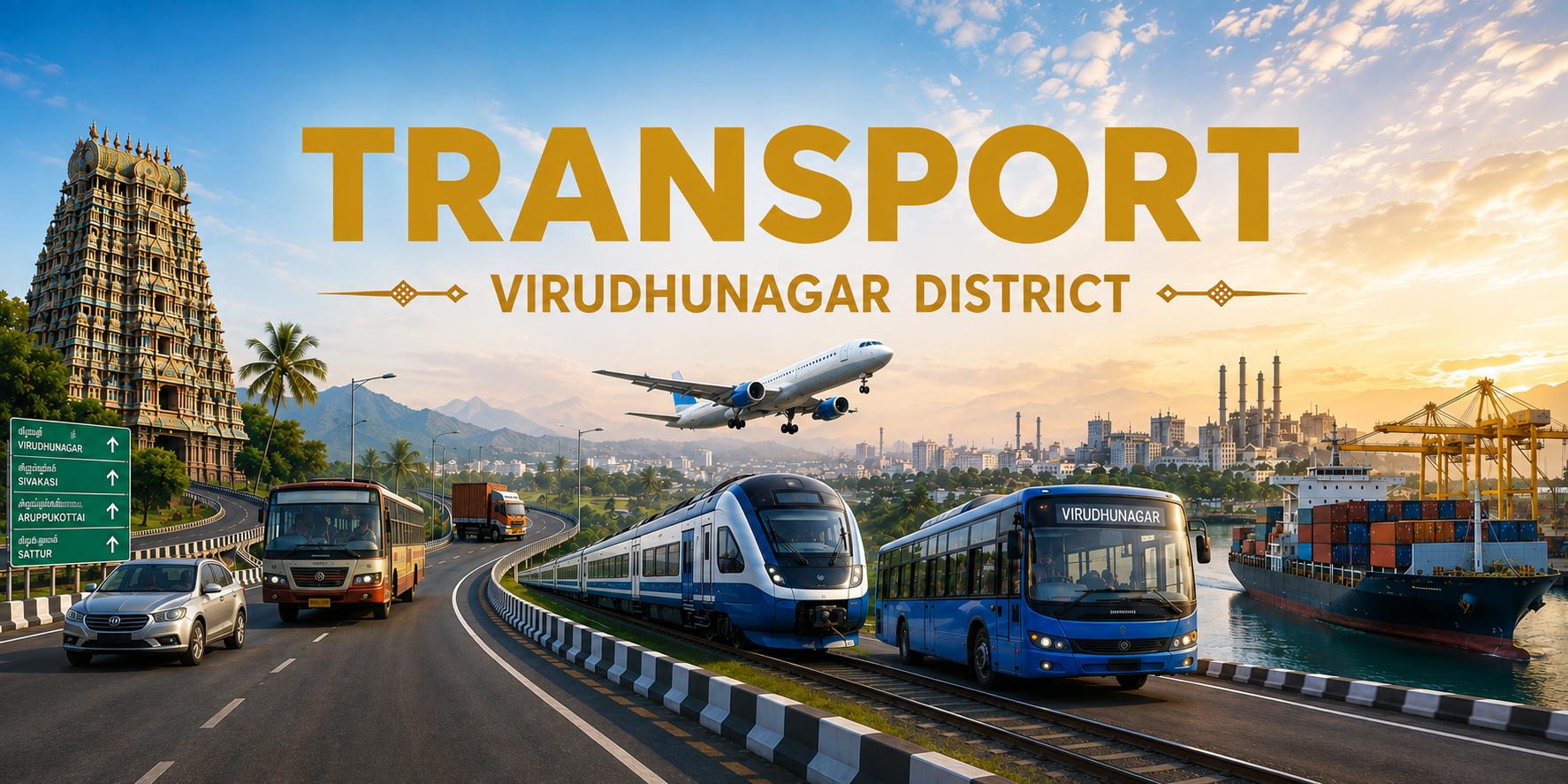
Transport in Virudhunagar District

Bus
Virudhunagar District has well-connected bus services linking major towns, villages, and nearby districts.
Train
Virudhunagar District has well-connected railway services connecting major towns with important cities in Tamil Nadu.

Aeroplane
Virudhunagar District is conveniently accessible through nearby airports, with Madurai International Airport.
Local Transport
Virudhunagar District has well-connected bus services linking major towns, villages, and nearby districts.
Virudhunagar District Complete Bus Connectivity
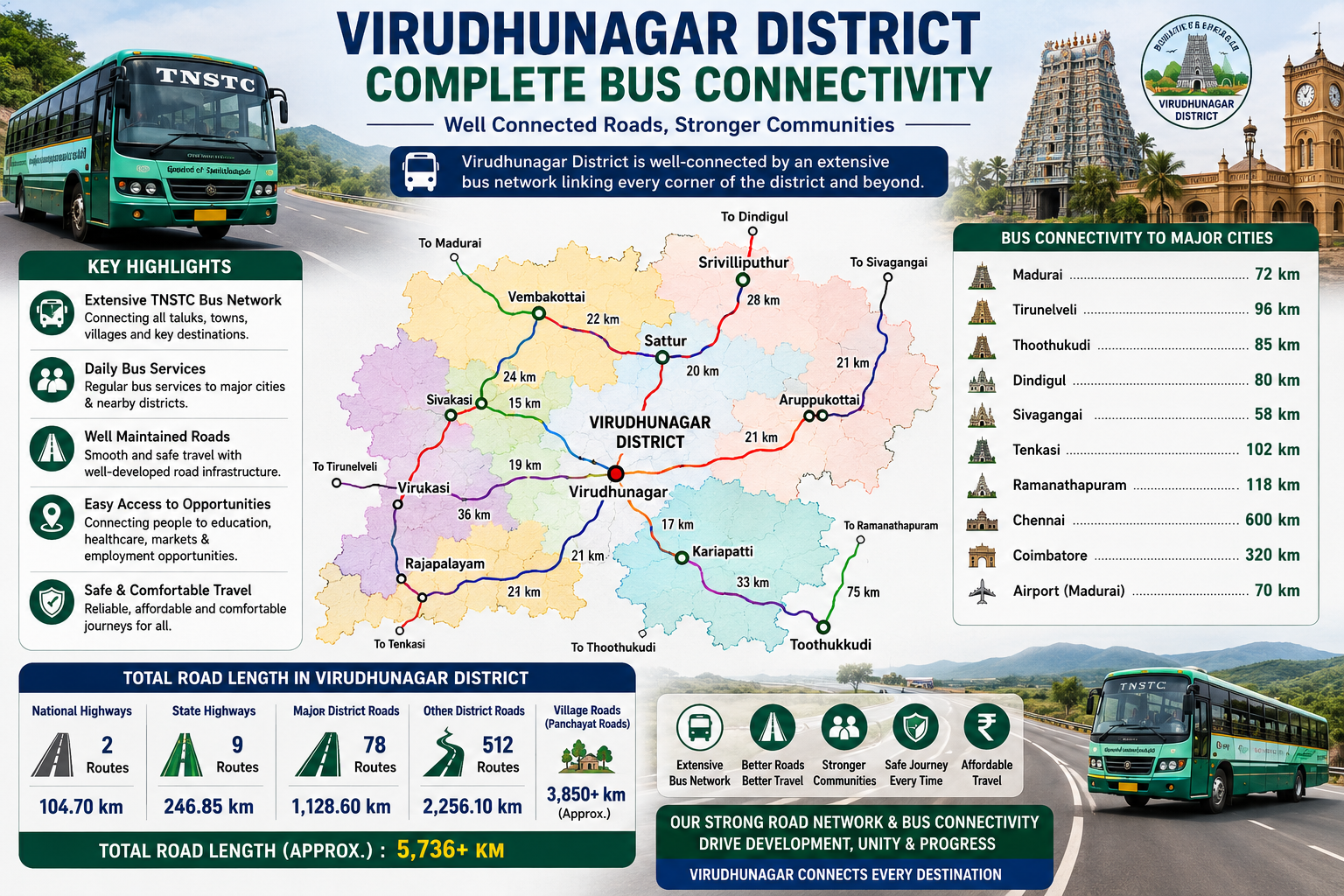
Virudhunagar District has a comprehensive and well-connected transportation network that plays a vital role in the social and economic development of the region. The district is served by an extensive Tamil Nadu State Transport Corporation (TNSTC) bus network, providing regular services between major towns, villages, commercial centres and neighbouring districts. The connectivity enables people from rural and urban areas to travel easily for education, employment, healthcare, business, shopping and other essential activities.
Major towns such as Virudhunagar, Sivakasi, Sattur, Srivilliputhur, Aruppukottai, Rajapalayam, Virudhunagar and Kariapatti are interconnected through an established network of roads and bus routes. These services also provide convenient connections to important cities including Madurai, Tirunelveli, Thoothukudi, Dindigul, Sivagangai, Tenkasi and Ramanathapuram. Long-distance connectivity extends to major cities such as Chennai and Coimbatore, while Madurai Airport provides an additional transportation option for passengers travelling to and from the district.
The district’s road infrastructure consists of National Highways, State Highways, Major District Roads, Other District Roads and Village Roads. The image indicates approximately 5,736+ km of total road length, including about 104.70 km of National Highways, 246.85 km of State Highways, 1,128.60 km of Major District Roads, 2,256.10 km of Other District Roads and more than 3,850 km of Village Roads. This extensive network helps connect even remote villages with major towns and service centres.
Good road connectivity is particularly important for agriculture and rural development. Farmers can transport agricultural products, raw materials and other goods to markets more efficiently. Better connections between villages and commercial centres also support local businesses, small industries and employment opportunities. In industrial areas such as Sivakasi, reliable transport facilities are especially important for workers, businesses and the movement of goods.
Bus connectivity also contributes significantly to education and healthcare access. Students from villages can travel to schools, colleges and training institutions in nearby towns, while residents can reach hospitals and healthcare centres without depending entirely on private transportation. Regular public transport is particularly beneficial for people who may not own private vehicles.
The district’s road network also supports tourism and pilgrimage travel. Important destinations and temple towns such as Srivilliputhur, Rajapalayam and other cultural and religious centres can be accessed through the district’s road and bus services. During major festivals and special events, improved transportation connectivity helps accommodate increased passenger movement.
The network highlighted in the image also emphasises safe, comfortable and affordable travel. Well-maintained roads and dependable bus services can reduce travel difficulties and improve mobility between communities. Strong connectivity helps bring rural and urban populations closer together and supports the movement of people, goods and services across the district.
Virudhunagar District Complete Train Connectivity
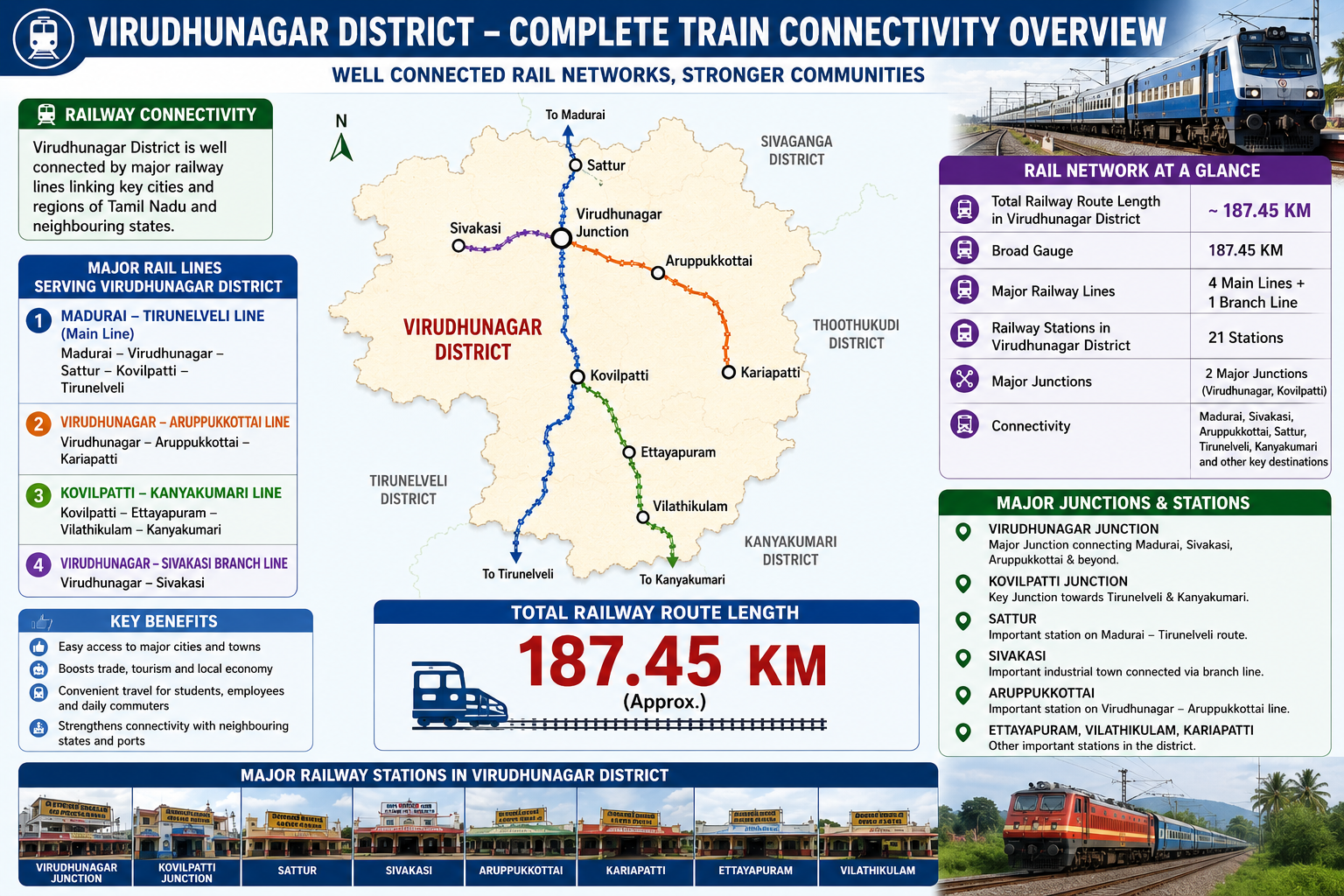
Virudhunagar District has a well-connected railway network that provides convenient transportation to major towns and cities across Tamil Nadu and neighbouring regions. The railway system plays an important role in connecting residents, students, employees, businesses and tourists with important destinations. The district has approximately 187.45 km of railway route length, with the entire network primarily consisting of Broad Gauge railway lines. The railway network includes four main railway lines and one branch line, along with around 21 railway stations and two major junctions at Virudhunagar Junction and Kovilpatti Junction.
The Madurai–Tirunelveli railway line is one of the major routes serving the district, connecting Madurai, Virudhunagar, Sattur, Kovilpatti and Tirunelveli. Another important route is the Virudhunagar–Aruppukkottai line, which connects Virudhunagar with Aruppukkottai and Kariapatti. The Kovilpatti–Kanyakumari line provides connectivity through Kovilpatti, Ettayapuram and Vilathikulam towards Kanyakumari. In addition, the Virudhunagar–Sivakasi branch line provides direct rail connectivity to the important industrial town of Sivakasi.
Virudhunagar Junction serves as a major railway junction and provides connections towards Madurai, Sivakasi, Aruppukkottai and other destinations. Kovilpatti Junction is another important railway junction, particularly for passengers travelling towards Tirunelveli and Kanyakumari. Other important stations highlighted in the district include Sattur, Sivakasi, Aruppukkottai, Kariapatti, Ettayapuram and Vilathikulam.
The railway network provides several important benefits to the district. It offers easy access to major cities and towns, supports the movement of agricultural and industrial goods, and strengthens trade and local economic activities. Railway services also provide an affordable and convenient mode of transportation for students, employees, daily commuters and long-distance passengers. Better rail connectivity supports tourism and pilgrimage travel and improves access to neighbouring districts and important commercial centres.
Rail transportation is particularly valuable for Sivakasi and other industrial areas, as railway connectivity can support the movement of workers and goods. Similarly, towns such as Aruppukkottai, Sattur and Kovilpatti benefit from their connections to larger transportation hubs. The network also helps rural and semi-urban communities access educational institutions, healthcare facilities, markets and employment opportunities in larger towns and cities.
Overall, the 187.45-km railway network forms an important part of Virudhunagar District’s transportation infrastructure. With major railway routes, junctions and stations connecting the district to Madurai, Tirunelveli, Kanyakumari, Sivakasi, Aruppukkottai and other destinations, the railway system contributes significantly to regional mobility, trade, tourism and economic development. A strong and reliable rail network therefore helps build better connectivity, stronger communities and greater opportunities throughout Virudhunagar District.
Virudhunagar District Complete Air Connectivity
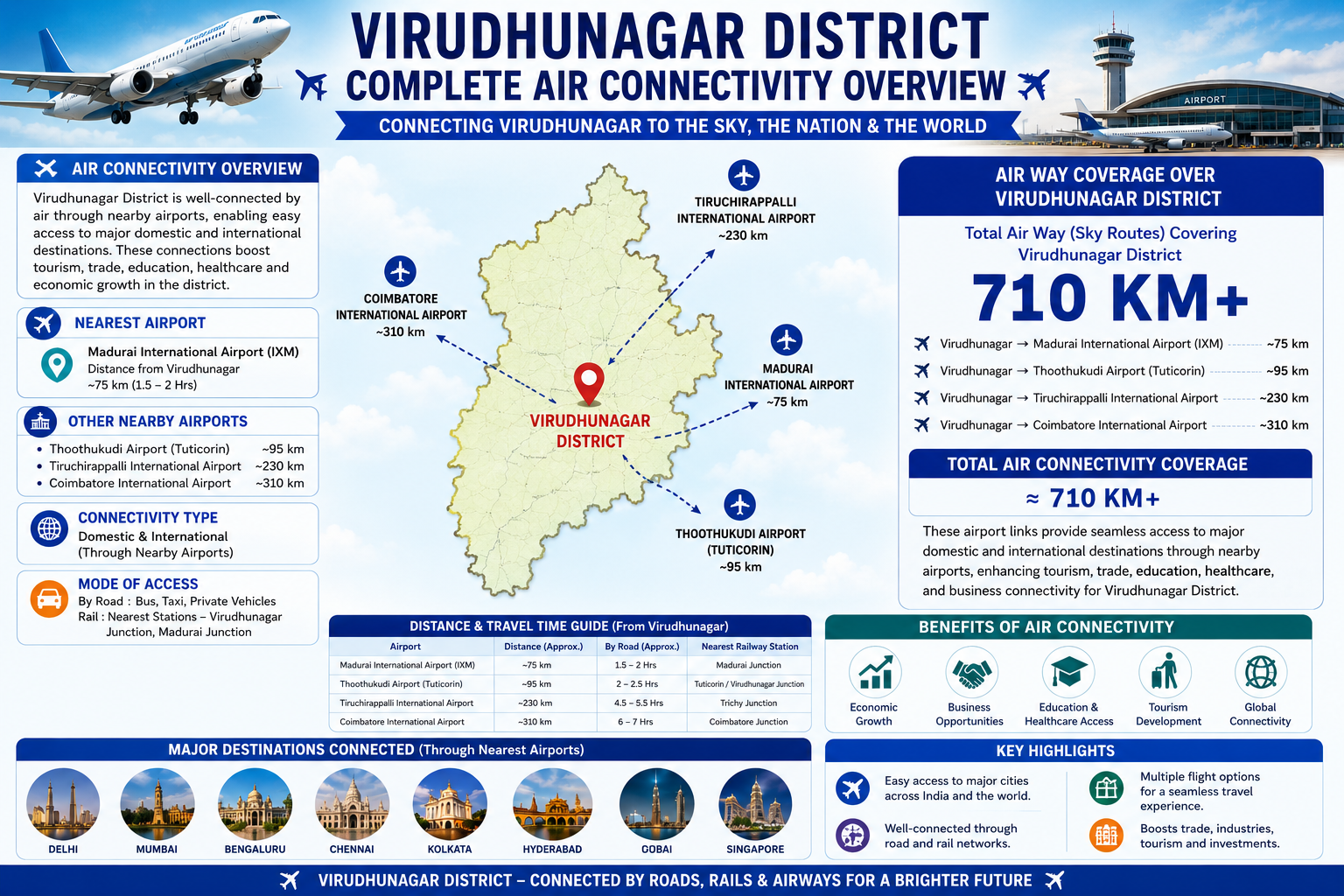
Virudhunagar District benefits from access to multiple airports in southern Tamil Nadu, providing convenient air travel for residents, tourists, entrepreneurs, students, and government officials. Madurai International Airport is the nearest major airport, approximately 75 km from Virudhunagar, offering connectivity to important cities and destinations. Thoothukudi Airport, located about 95 km away, provides an additional option for regional air travel, while Tiruchirappalli International Airport and Coimbatore International Airport offer wider domestic and international connectivity.
The district is well connected to these airports through national highways, state highways, railway stations, buses, taxis, and private vehicles, making airport access relatively convenient from different parts of the district. The availability of multiple airport options is particularly beneficial for people travelling for business, education, healthcare, employment, tourism, and trade.
Improved air connectivity can also support the movement of business professionals, investors, tourists, and entrepreneurs, contributing to the development of local industries and commercial activities. It helps connect Virudhunagar with major urban centres such as Chennai, Bengaluru, Mumbai, Delhi, Hyderabad, Kolkata, and other important destinations. International connectivity through nearby airports also provides opportunities for residents and businesses to access global destinations.
Overall, the availability of nearby airports and supporting road and rail networks strengthens Virudhunagar District’s regional and national connectivity, while contributing to tourism development, economic growth, business opportunities, and improved access to essential services.
Virudhunagar District Complete Local Transport Connectivity
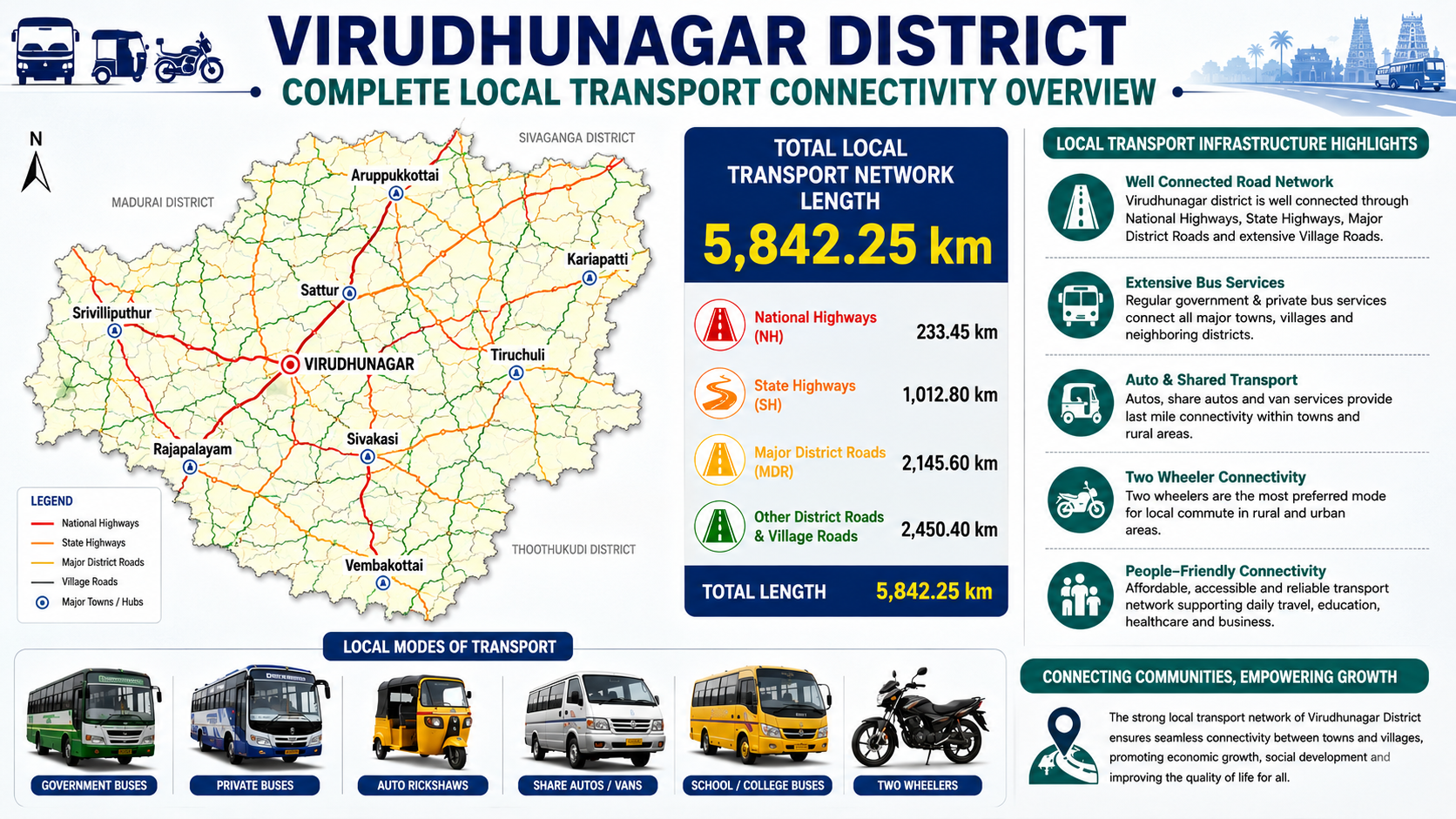
Virudhunagar District has an extensive and well-connected local transport network that links urban centres, towns, villages, and surrounding districts. The district’s transport infrastructure includes National Highways, State Highways, Major District Roads, other district roads, and village roads, creating convenient routes for both short- and long-distance travel. The image indicates a total local road network of approximately 5,842.25 km, demonstrating the important role of road connectivity in the district’s development.
The district is served by a combination of government and private bus services, providing regular connectivity between major towns and rural areas. Important transport hubs include Virudhunagar, Sivakasi, Srivilliputhur, Rajapalayam, Sattur, Aruppukottai, Kariapatti, Tiruchuli, and Vembakottai. These connections enable residents to travel conveniently for work, education, healthcare, shopping, government services, and other daily activities.
For short-distance and last-mile travel, auto-rickshaws, shared autos, vans, and two-wheelers play an important role, particularly in villages and areas where regular bus services may be limited. School and college buses also provide dedicated transportation for students, supporting access to educational institutions across the district.
A strong local transport network contributes significantly to economic growth, employment, tourism, trade, education, and social development. Better road connectivity enables farmers and local businesses to transport goods to markets, helps industries access nearby commercial centres, and makes important services more accessible to rural communities.
Overall, Virudhunagar District’s combination of roads, buses, shared transport, auto-rickshaws, vans, and two-wheelers provides people-friendly mobility across the district. Continued improvement and maintenance of these transport facilities can further strengthen connectivity, reduce travel difficulties, support rural development, and improve the overall quality of life for residents.