Breaking News

Breaking News

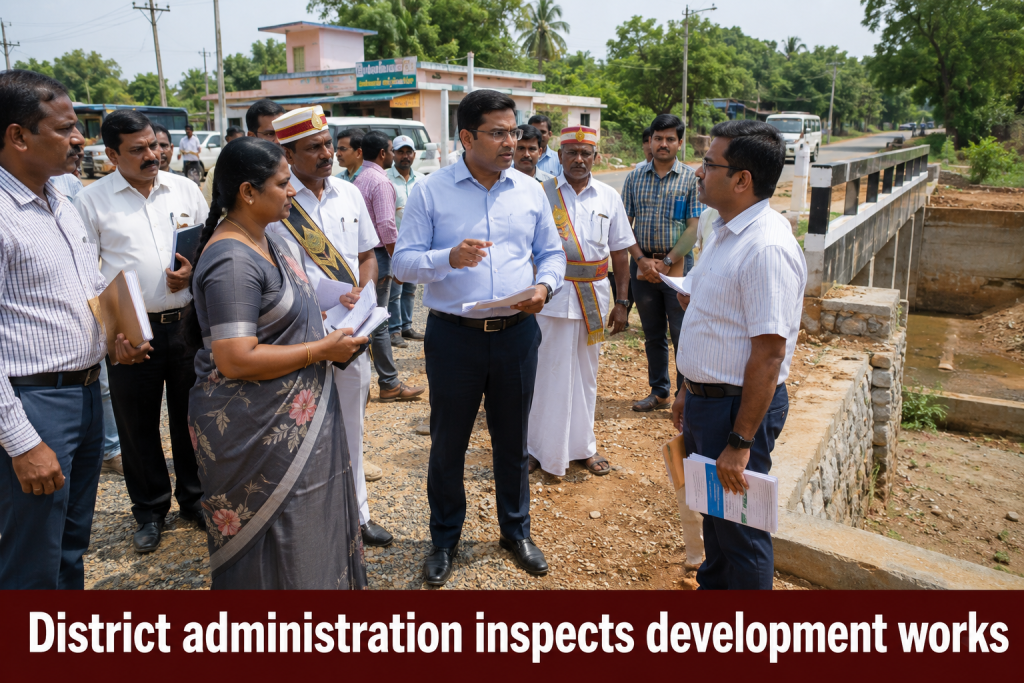
District administration inspects development works

Virudhunagar District Collector Dr. N. O. Sukhaputra, IAS, conducted a field inspection in Srivilliputhur Taluk on 20 August 2026 as part of the district administration’s “Ungalai Thedi, Ungal Ooril” outreach programme. The official Virudhunagar district administration has confirmed the field inspection. Field-level review The inspection was aimed at reviewing the implementation and progress of government development and welfare schemes at the ground level. Field inspections of this nature enable district officials to assess whether projects are progressing according to plan and whether the intended benefits are reaching residents. The Collector and accompanying officials visited project locations and reviewed the condition and progress of works being undertaken in the area. The administration’s approach focuses on identifying implementation issues and resolving them through coordination between the concerned departments. Focus on public infrastructure and services The inspection forms part of the district administration’s continuing effort to monitor public infrastructure, basic amenities and government schemes directly at the field level. Earlier official district releases also record Dr. Sukhaputra conducting on-site inspections of infrastructure and drinking-water-related works. Such inspections are important because they allow officials to examine the actual condition of facilities rather than relying solely on departmental reports. Problems relating to construction quality, delays, maintenance or service delivery can consequently be brought to the attention of the responsible departments. Importance for residents Field-level monitoring can help ensure that government-funded projects are completed on time and that public facilities are properly maintained. It also provides an opportunity for local issues to be communicated directly to senior district officials. The Virudhunagar district administration has continued to use field inspections and public-outreach programmes as part of its monitoring mechanism. The official district website lists 20 August 2026 as the date of the Srivilliputhur field inspection by the District Collector. Administrative significance The inspection demonstrates the importance of direct monitoring, inter-departmental coordination and timely corrective action in implementing government schemes. Regular visits to project sites can help the administration identify shortcomings early and improve the effectiveness of development programmes across the district.

Breaking News

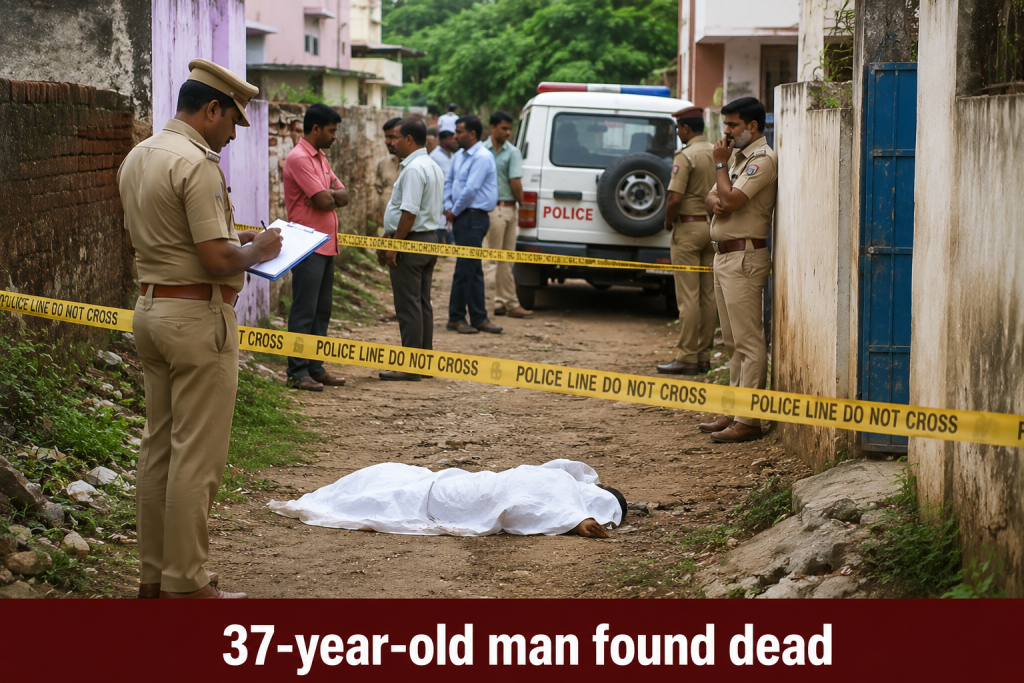
37-year-old man found dead

If you give me the date, village/town, victim’s name, or the newspaper/source where you saw this report, I can search for that exact incident and prepare the full magazine-style details, including: For now, the safest headline is: 37-Year-Old Man Found Dead in Virudhunagar District — Circumstances Under Investigation

Breaking News

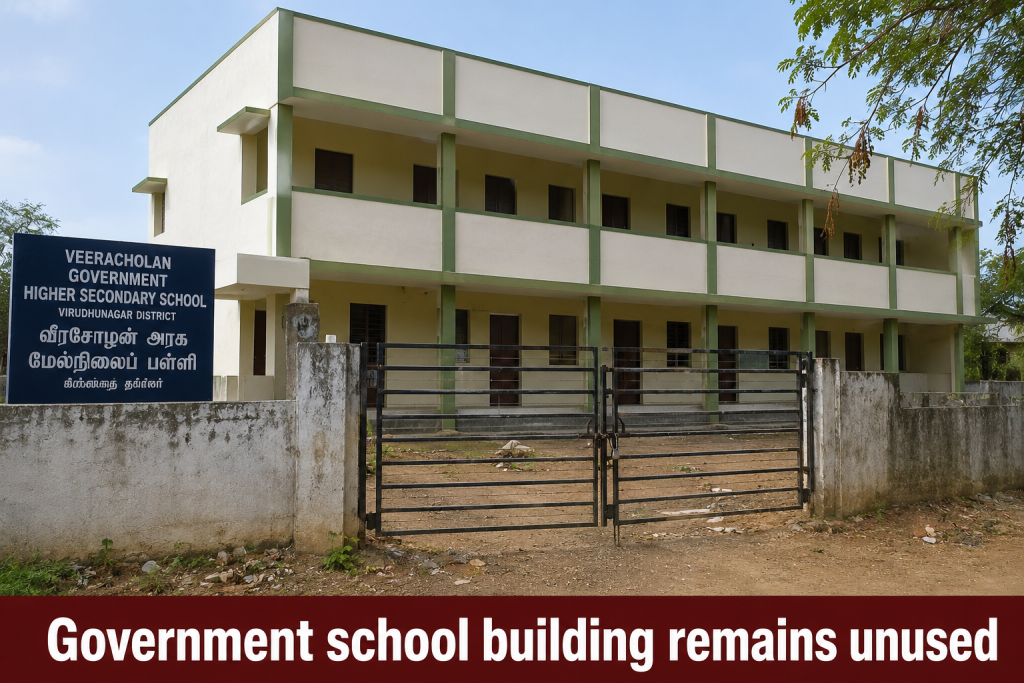
Government school building remains unused

A newly constructed classroom block at Veeracholan Government Higher Secondary School in Narikudi Union, Virudhunagar district, has reportedly remained locked for about six months after construction was completed, leaving more than 850 students to continue using the school’s older building. The issue was reported on 18 August 2026. New building constructed at ₹3.06 crore The new facility consists of 13 classrooms and was built at a cost of approximately ₹3.06 crore, with financial assistance from NABARD. It was intended to address the school’s growing infrastructure requirements and provide students with additional classroom space. However, despite construction and finishing work reportedly being completed around six months earlier, the classrooms had not been opened for regular academic use. Students continue in an ageing building The delay has become a concern because students and teachers are still using the school’s around 35-year-old building. Reports indicate that portions of the older structure, including sections of the roof and walls, are in poor condition and may pose safety concerns. Parents have expressed concern that students are continuing to study in an ageing structure even though a newly constructed building is available on the same school premises. Parents demand immediate opening Parents and social activists have urged the district administration and School Education Department to take immediate action and make the new classrooms operational. Their concern is that continued use of the old building could expose students and teachers to unnecessary risks, particularly if damaged portions of the structure deteriorate further. They have also requested that officials inspect the old building and introduce appropriate safety measures until the new facility is opened. Key issue The situation has raised questions about the gap between completion of public infrastructure and its actual utilisation. A substantial investment has already been made in the 13-classroom facility, but students have reportedly not yet benefited from the new infrastructure. For a Virudhunagar district magazine: This issue highlights the need for timely administrative procedures after construction, ensuring that completed government school infrastructure is handed over and made available to students without unnecessary delay.

Breaking News

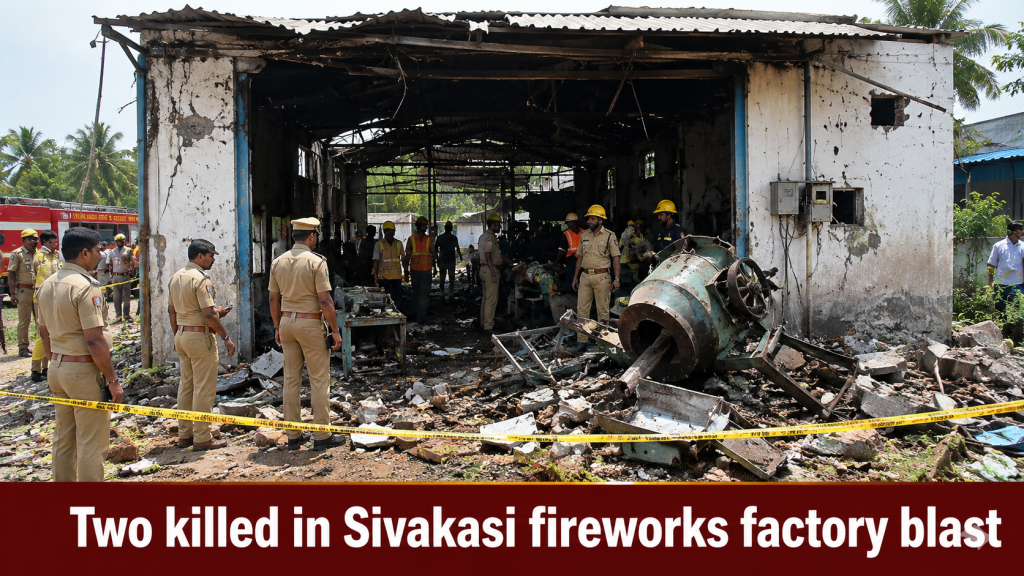
Two killed in Sivakasi fireworks factory blast

A fatal explosion occurred at a licensed fireworks manufacturing unit near Sivakasi in Virudhunagar district on Thursday, 13 August 2026. The incident took place at Krishna Pyrotechnics, located near Namaskarithanpatti, while workers were reportedly testing a newly purchased chemical-mixing machine. What happened? According to reports, the explosion occurred during testing of the new machine used for mixing chemicals in fireworks production. The blast triggered a fire inside the factory and caused the deaths of two men. The incident has once again highlighted the risks involved in chemical handling and machinery operations within Sivakasi’s fireworks industry. Victims The deceased were identified as: Safety concerns The accident has renewed concerns about safety procedures in fireworks manufacturing, particularly during chemical mixing, machinery operation and testing of newly installed equipment. Fireworks production involves highly combustible and explosive materials, making strict adherence to safety protocols essential. The incident comes amid wider scrutiny of safety practices in Virudhunagar’s fireworks sector. The Madras High Court has previously criticised regulatory lapses and called for stronger enforcement of safety requirements, including inspections, qualified safety personnel and compliance with licensing and storage rules. Investigation Authorities are expected to investigate the circumstances surrounding the machine testing and determine how the explosion occurred, including whether required safety procedures were followed. The exact technical cause should be treated as under investigation until officials release their findings. Wider significance Sivakasi is a major centre of India’s fireworks industry, making worker safety a continuing concern. The latest incident demonstrates the importance of regular safety inspections, proper chemical handling, machine safeguards, worker training and strict compliance with explosive-material regulations.

Breaking News

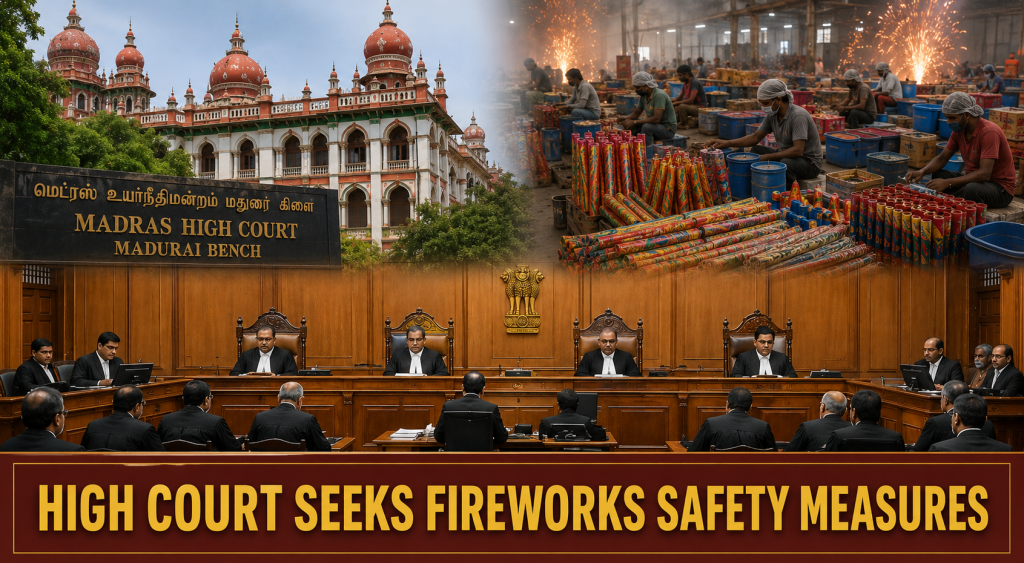
High Court seeks fireworks safety measures

The Madurai Bench of the Madras High Court has intensified its scrutiny of fireworks manufacturing in Virudhunagar district, particularly following repeated accidents in fireworks units. On 17 August 2026, the Court directed the Virudhunagar District Collector and Superintendent of Police (SP) to submit their recommendations to the Chairperson of the Virudhunagar District Legal Services Authority (DLSA) on regulating fireworks units and preventing accidents. Why did the High Court intervene? The proceedings arise from a long-running group of petitions concerning accidents, deaths and injuries in fireworks manufacturing units in Virudhunagar district. The litigation includes a suo motu proceeding initiated in 2014, along with petitions seeking stronger regulation of the fireworks industry and compensation for families of workers killed in accidents. The Court’s concern is that accidents have continued to occur despite the existence of licensing requirements and safety regulations. In April 2026, the Court had already directed the Tamil Nadu Government to file a comprehensive report explaining what measures were being taken to prevent recurring fireworks-unit accidents. The April 2026 Kattanarpatti tragedy The latest judicial scrutiny gained urgency after a major explosion at a fireworks unit in Kattanarpatti village, Virudhunagar district, on 19 April 2026, in which 25 people were killed. Following the tragedy, the Court sought suggestions on preventing similar incidents and examined questions concerning safety, regulation and compensation. The Court also sought information about whether fireworks units involved in accidents were properly licensed and whether authorities had taken action in cases where violations were found. What did the Court ask the authorities to do? The Court’s recent direction requires the Collector and SP to submit their recommendations to the DLSA Chairperson. The DLSA Chairperson is then expected to consolidate the views of the various authorities and submit a report to the High Court. The Court issued this direction because officials from several departments had already participated in a meeting on 6 August 2026, but the Collector and SP had not yet submitted their suggestions. Meeting of officials At an earlier hearing, the Court directed the Chairperson of the Virudhunagar DLSA to convene a meeting involving relevant government departments and stakeholders. The participants were expected to include officials connected with: The purpose was to develop an effective system for regulating fireworks units and preventing accidents. Why are the Collector and SP important? The two officers have different but complementary responsibilities. District Collector The Collector is responsible for important aspects of district-level administration and regulation, including coordination with departments involved in licensing, revenue, industrial safety and disaster management. Superintendent of Police The SP has an important role in: The Court therefore wants recommendations from both administrative and law-enforcement perspectives. Licensing and illegal units One of the issues under examination is whether fireworks manufacturing units are operating with valid licences and complying with the conditions attached to those licences. In June 2026, the High Court specifically asked the State Government to provide information on whether fireworks units were licensed by the District Revenue Officer and Petroleum and Explosives Safety Organisation (PESO). The Court also asked about cases registered following accidents and the status of those cases. This is important because possessing a licence does not mean that a unit can ignore safety conditions. Units must comply with the applicable requirements under the Explosives Act, 1884 and Explosives Rules, 2008, as well as other relevant safety regulations. Periodic inspection The court proceedings have also focused on the need for regular inspection of fireworks manufacturing units. A petition before the Court sought directions requiring authorities to periodically inspect all fireworks manufacturing units in Virudhunagar and take appropriate action wherever licences were being misused or licence conditions were not being followed. This reflects a central issue in the case: Safety rules are effective only when compliance is regularly checked and violations result in timely enforcement. Proposed online monitoring system Another significant issue raised by the High Court is the possibility of creating an online portal containing information about fireworks units operating in Virudhunagar district. The Court asked the Collector to provide information on whether such a portal could enable members of the public to: This could give residents a direct way to alert authorities about potentially unauthorised operations. Safety measures under consideration The Court has sought innovative safety measures to reduce accidents rather than relying only on conventional inspections. Areas that have come under consideration include: The Court has also asked for information on insurance coverage and compensation available to workers employed in fireworks units. Existing restrictions in Virudhunagar The Court’s February 2026 judgment provides important historical context. The judgment records that, in 2013, the Virudhunagar Collector had noted the very high concentration of fireworks factories and explosive magazines in the district. Because of the safety concerns arising from this concentration, fresh explosives licences were prohibited in the Sivakasi, Sattur and Virudhunagar taluks under that administrative order. The order allowed licensing in certain other taluks, subject to the Collector being satisfied about the applicant’s purpose and compliance with statutory requirements. This demonstrates that the district has faced concerns about the geographical concentration of fireworks-related activities for many years. Worker safety Worker protection is a central part of the judicial proceedings. Fireworks manufacturing involves hazardous materials and processes, meaning that workers can face serious risks if safety procedures are ignored. The Court’s proceedings have therefore considered: The Court has also emphasised the importance of balancing the economic importance of the industry with the need to protect workers. In its February 2026 judgment, the Court recognised that the fireworks industry provides employment to a substantial section of Virudhunagar’s population while also stressing that fatal accidents cannot be ignored. Economic importance versus safety This is an important aspect of the Court’s approach. Sivakasi and surrounding areas have a major fireworks industry that provides employment and supports many families. Completely ignoring the industry’s economic importance could have serious consequences for livelihoods. At the same time, repeated explosions and workplace deaths demonstrate that economic activity cannot come at the expense of basic worker and public safety. The judicial proceedings

Breaking News

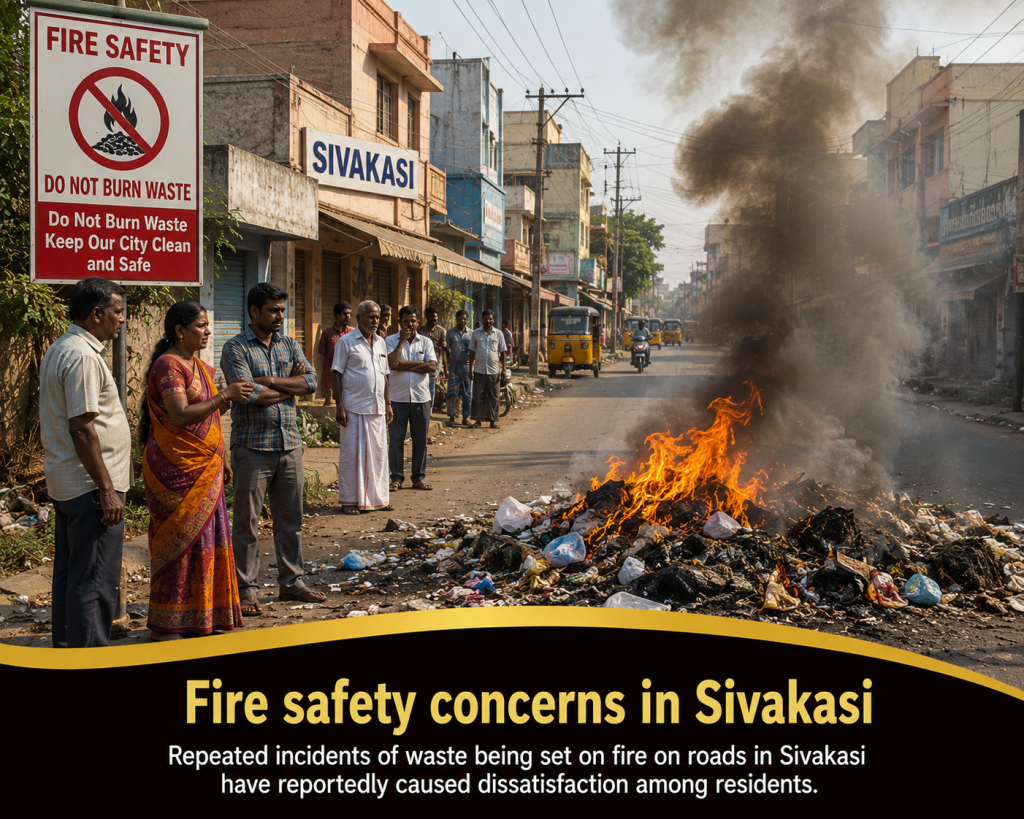
Fire safety concerns in Sivakasi

Repeated incidents of waste and discarded materials being set on fire along roadsides in Sivakasi have raised concerns among residents, particularly because Sivakasi is a major fireworks-manufacturing centre. A recent incident reported on 23–24 August 2026 involved waste, plastic and firecracker-related waste being burnt near the Sattur Road at Paraipatti, while similar incidents have reportedly occurred along Sattur Road, Vembakottai Road and Thiruthangal Road. What happened? According to the recent report, waste had been dumped along roadsides instead of being removed promptly. Some of the accumulated waste was subsequently set on fire. The material reportedly included: At Meenampatti near Sattur Road, waste reportedly had been burnt two days before the Paraipatti incident, producing thick smoke that affected motorists travelling through the area. A further fire was reported near Paraipatti on Sattur Road, where roadside garbage and firecracker waste caught fire. The flames reportedly became intense enough to damage nearby trees. Fire and Rescue Services personnel responded quickly and extinguished the fire, preventing what could have been a more serious incident. Why is this particularly serious in Sivakasi? Sivakasi has an unusually high level of fire-related industrial activity because of its large fireworks industry. This means that careless disposal or burning of combustible material presents a greater safety concern than ordinary roadside garbage burning. An earlier incident in March 2026 illustrates the risk. Firecracker waste was reportedly burned illegally in an open area near Anaikuttam, producing repeated explosion-like sounds. Fire and Rescue Services personnel were called and extinguished the fire. Officials said fireworks units are required to dispose of waste in designated burning pits within their premises rather than in open areas. Risk from firecracker waste Firecracker manufacturing waste can contain combustible and potentially explosive residues. Burning such material in an uncontrolled location can therefore result in: This is why disposal of fireworks waste requires substantially more care than ordinary household garbage. Danger to motorists Roadside fires create a direct traffic hazard. When garbage burns close to a road, smoke can spread across the carriageway and significantly reduce visibility. The recent Meenampatti incident reportedly caused heavy smoke that made it difficult for motorists to travel through the affected area. This can increase the possibility of: Environmental and health concerns Open burning of mixed waste can produce smoke and harmful pollutants, particularly when plastics and other synthetic materials are involved. Residents can experience short-term problems such as: Repeated burning also contributes to local air pollution and leaves ash and partially burned material along roadsides. Damage to trees and surroundings The Paraipatti fire reportedly damaged trees located close to the burning waste. This demonstrates how a small roadside waste fire can spread beyond the original pile. Dry vegetation, plastic and other combustible materials can allow flames to move quickly, particularly during hot and dry weather. Concern because of nearby fireworks shops One of the most serious aspects of the recent incident was its proximity to firecracker shops. The fire was reportedly brought under control quickly by Fire and Rescue Services personnel, helping to prevent a potentially much larger accident. In a city associated with fireworks production and sales, authorities need to be particularly cautious about allowing combustible waste to accumulate near roads, commercial establishments and fireworks-related premises. Waste-management problem Residents’ concerns are not limited to the act of setting waste on fire. The underlying problem is also the continued dumping of garbage along roadsides. Reports identify several roads where waste has reportedly been dumped, including: When waste is allowed to remain for long periods, it creates opportunities for accidental or deliberate burning. What residents are demanding Residents reportedly want the authorities to take action on both sides of the problem: 1. Prevent roadside dumping Garbage should not be allowed to accumulate on public roads. 2. Remove existing waste quickly Waste that has already been dumped should be cleared before it becomes a fire hazard. 3. Prevent open burning Authorities should identify and take action against those deliberately setting waste on fire. 4. Pay special attention to firecracker waste Fireworks-related waste should be handled through appropriate disposal procedures rather than being dumped or burned in uncontrolled locations. 5. Increase monitoring Roads and locations where waste repeatedly accumulates should be monitored more closely. Existing waste-management rules Sivakasi’s municipal solid-waste management framework prohibits dumping solid waste on roads and other public places and provides for action against violations. The city’s published Solid Waste Management By-laws also place responsibility on waste generators to hand over waste according to the prescribed collection and segregation system. Therefore, the solution is not simply to extinguish fires after they occur. Preventing roadside accumulation and ensuring proper waste collection and disposal are essential fire-prevention measures. Role of Fire and Rescue Services Fire and Rescue Services have an important emergency-response role when roadside waste catches fire. In the recent Paraipatti incident, firefighters reportedly reached the location quickly and extinguished the flames before the situation escalated. Sivakasi has a Fire and Rescue Services station at 34/7, Thiruthangal Road, according to the Sivakasi City Municipal Corporation’s official information. However, emergency response should be the last line of defence. The more effective approach is to prevent combustible waste from accumulating in unsafe locations in the first place. Broader significance The repeated incidents highlight the connection between waste management, public health, road safety and fire prevention in Sivakasi. This is especially important because the city has a large fireworks ecosystem. Even a relatively small roadside waste fire can become more dangerous if combustible or fireworks-related material is present nearby. The issue therefore calls for coordination between: Overall The recent roadside fires are not merely a cleanliness issue. They represent a public-safety and fire-risk problem.

Breaking News

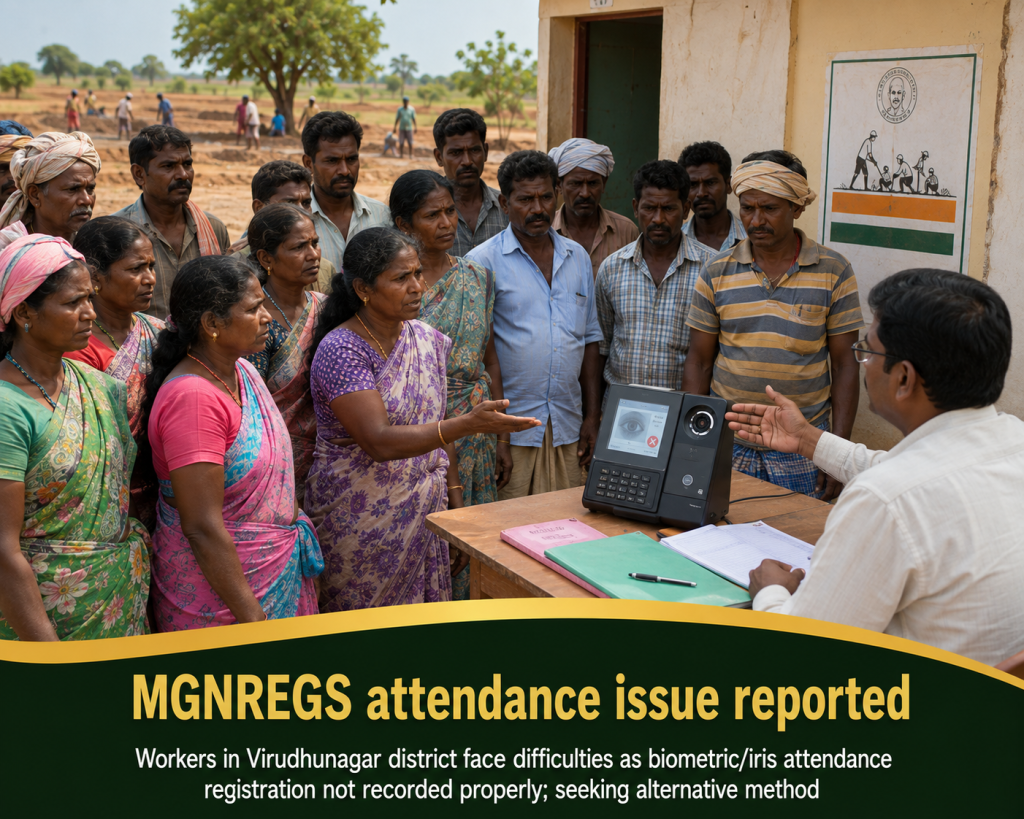
MGNREGS attendance issue reported

In July 2026, concerns were raised over difficulties faced by workers in Virudhunagar district in recording attendance under the rural employment programme. Workers reportedly encountered problems with biometric/iris-based authentication, and some sought an alternative method so that technical difficulties would not prevent them from having their attendance properly recorded and, consequently, affect their wage payments. There is an important distinction here: the broader government system for rural-employment attendance has moved toward digital and biometric/face-authenticated attendance, while the specific Virudhunagar complaint concerns difficulties workers experienced with the authentication process. What is the attendance system? Attendance under the rural employment programme has increasingly been digitised to improve transparency and ensure that wages are paid for work actually performed. Under the earlier MGNREGS system, the National Mobile Monitoring System (NMMS) was used to capture worksite attendance through time-stamped and geo-tagged photographs. From January 2023, NMMS-based attendance became applicable to eligible worksites, with provisions for offline capture where connectivity was unavailable. Following the transition to the Viksit Bharat–Guarantee for Rozgar and Ajeevika Mission (Gramin) (VB-G RAM G) framework from 1 July 2026, attendance mechanisms include face-authentication-based systems, along with exception provisions intended to prevent genuine workers from losing benefits because of technical or connectivity problems. What problem did Virudhunagar workers report? The reported problem was that some workers were unable to get their biometric/iris attendance recorded properly. Possible difficulties with biometric authentication can include: For a daily-wage worker, this is a serious issue because attendance is directly connected with the official record of employment and ultimately the processing of wages. Why are workers asking for an alternative? Workers’ main concern is that a technical failure should not be treated as absence. If a person has actually worked but the digital system fails to record the attendance, there is a risk of a mismatch between the work performed and the official attendance record. Therefore, workers have sought an alternative attendance mechanism for cases where biometric/iris authentication cannot be completed successfully. The broader national system already recognises this type of problem. The Rural Development Ministry has provided mechanisms for exceptional circumstances in which digital attendance cannot be uploaded, including provisions for authorised officials to upload manual attendance. Why attendance is important Attendance is not merely an administrative formality. It forms an important part of the process used to establish that a worker participated in a sanctioned employment worksite. The basic chain is: Worker reports for work → attendance is recorded → work participation is verified → wage calculation → wage payment If attendance is not captured correctly, the subsequent stages can potentially be affected. Risk of delayed wages For rural workers who depend on employment-programme wages for household expenses, even a short delay can be significant. The Union Government has said that digital attendance is intended to improve efficiency and enable wage processing more quickly. Under the NMMS system, wage lists and Fund Transfer Orders can be generated on the same day that attendance is captured. Consequently, workers are particularly concerned that authentication failures should not result in: Technical problems are already recognised by the government The Centre has acknowledged that digital attendance systems can face technical and connectivity problems. For NMMS, the government introduced an offline attendance facility so that attendance could be captured even when a worksite has poor network connectivity and uploaded later when connectivity becomes available. The system has also been continuously modified in response to problems reported by states and field-level users. This is important because rural worksites can be located in areas where mobile connectivity, device performance or authentication conditions are not always reliable. Special concern for vulnerable workers The issue is particularly important for workers who may have difficulty completing biometric authentication. A July 2026 report from Tamil Nadu, for example, documented the case of a visually challenged MGNREGS worker who was denied wages after difficulties with e-KYC and biometric authentication, despite an exemption applicable to persons with disabilities. The case illustrates the wider concern that technological requirements should not unintentionally exclude eligible workers. This does not establish that the Virudhunagar workers were facing the same circumstances, but it demonstrates why exception mechanisms and proper assistance are important. What an effective alternative could involve Where authentication genuinely fails, workers’ demand for an alternative method could be addressed through mechanisms authorised by the programme administration. Depending on the applicable rules and circumstances, this could involve: The exact alternative should be authorised by the competent rural-development authorities rather than workers being asked to create their own attendance system. Grievance redressal Workers who believe their attendance has not been recorded correctly can raise the matter through the programme’s grievance mechanisms. The Union Government has stated that MGNREGS complaints can be made through: The government has also stated that the programme provides grievance-redressal mechanisms at the Block and District levels. For a district-level problem such as the one reported in Virudhunagar, the Block Development Office and district rural-development authorities are therefore important points for follow-up. What workers are seeking The core demand can be summarised as: Workers who genuinely attend and perform MGNREGS work should not lose their attendance or wages because a biometric/iris authentication system fails. They are seeking a reliable backup mechanism that can record attendance when the primary authentication method does not work. Broader significance The Virudhunagar issue highlights the challenge of balancing digital transparency with accessibility for rural workers. Digital attendance can help prevent fraudulent attendance, improve monitoring and speed up wage processing. However, the system also needs effective exception handling so that genuine workers are not disadvantaged by device failures, authentication errors, connectivity problems or other technical barriers. The government’s current position recognises this need: the March 2026 PIB release specifically states that exception provisions exist to avoid inconvenience to workers and that technical issues are taken up for resolution.

About
News
Home
Magazine
Contact