Latest news

Latest news

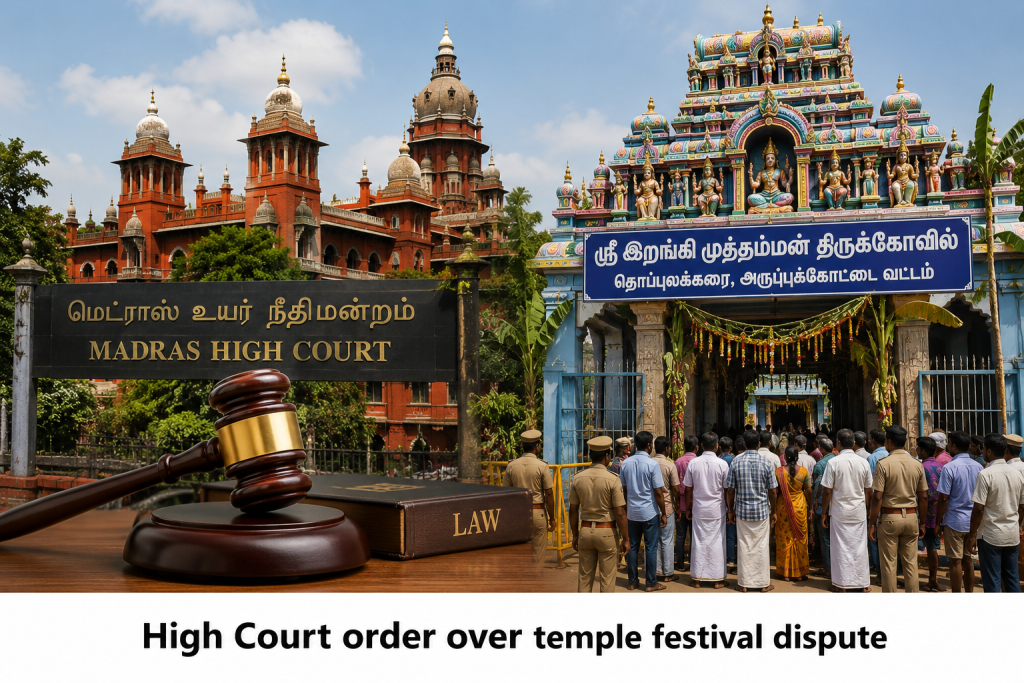
High Court order over temple festival dispute

The Madurai Bench of the Madras High Court, in an order dated August 3, 2026, dealt with a long-running dispute concerning Arulmigu Sri Renganachiamman Temple, also known as Sri Irangi Muthamman Temple, at Thoppulakkarai in Aruppukkottai Taluk, Virudhunagar district. The immediate issue was permission to conduct the Aadi festival scheduled from August 10 to 14, 2026, amid competing claims over the temple’s administration and customary festival rights. Background of the dispute The dispute is not new and has reportedly continued for several years. One group claimed that the temple and its festivals had traditionally been managed by six communities — Maravar, Agamudaiyar, Vellalar, Asari, Iyengar and Pandaram. Members of the Rajakambala Nayakkar community, however, disputed the claim of exclusive control and sought participation in the administration and festival rituals. The competing sides presented different accounts of the temple’s historical management and customary practices. The High Court noted that the dispute involves much more than the arrangements for a single festival. Questions concerning ownership, administration, customary practices, ritual rights and the right to organise festivals remain contested. Request for police protection A petitioner associated with the festival committee approached the High Court after authorities refused permission for the proposed Aadi festival. The petitioner sought an order directing the police to provide protection so that the festival could be conducted from August 10 to August 14, 2026. The police had refused permission because of the history of conflict between the groups and the authorities’ assessment that permitting one faction to conduct the festival could create a law-and-order problem. The court noted that previous disputes had resulted in criminal cases, including cases relating to unlawful assembly, rioting, assault, damage to property and obstruction of public servants. Revenue Divisional Officer’s order The Revenue Divisional Officer (RDO), Aruppukkottai, had conducted an enquiry on July 6, 2026, involving officials and representatives of the competing groups. The RDO subsequently issued proceedings on July 10, 2026. Among other things, the proceedings stated that no community should prevent members of another community from worshipping at the temple and that parties claiming ownership or customary rights should approach the competent Civil Court. The RDO also directed that no individual community should conduct a separate festival while the underlying dispute remained unresolved. What the High Court decided The High Court declined to issue a positive direction allowing the petitioning faction to conduct the 2026 Aadi festival with police protection. The court reasoned that granting such permission to one faction could effectively appear to recognise that faction’s disputed claim to administer the temple or conduct its festival. The court held that the writ proceedings were not the appropriate forum to determine those underlying civil and customary rights. Importantly, the court did not decide which faction owns or controls the temple. Instead, it directed the parties to approach the competent Civil Court for a comprehensive determination of their respective claims. Why the Civil Court is important The High Court observed that determining the competing claims would require examination of evidence concerning: Such questions require pleadings, documentary evidence and oral evidence, which are more appropriately examined by a Civil Court rather than decided through writ proceedings. Earlier court orders The High Court also examined several earlier proceedings concerning the temple. It emphasised that festival-specific orders passed in previous years should not automatically be treated as permanent declarations of ownership or customary rights. The court said that previous directions concerning particular festivals were made to address immediate situations and did not necessarily finally determine the long-term rights of either faction. Right to worship protected Although the court refused to recognise either faction’s exclusive festival claim, it made an important distinction between the right to worship and the right to administer the temple. The court directed that people should not be prevented solely because of their caste or community from offering ordinary worship, subject to reasonable regulation and any orders of a competent court. At the same time, ordinary worship does not automatically create a right to administer the temple, hold its keys, collect contributions, organise festivals or perform disputed rituals. Those matters must be established through the appropriate legal process.
Latest news

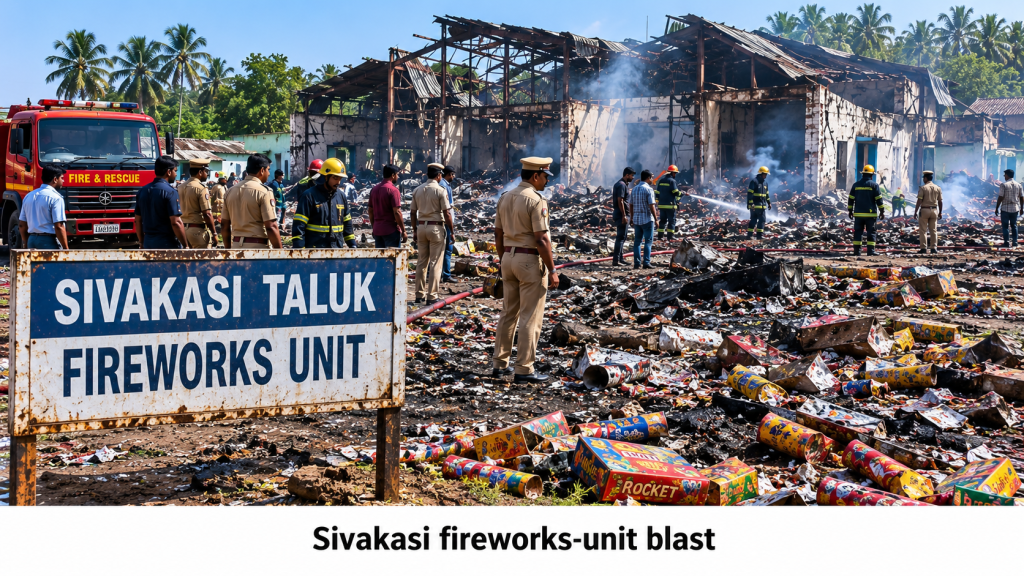
Sivakasi fireworks-unit blast

A fatal explosion occurred at a privately owned fireworks manufacturing unit in Namaskarithanpatti near Sivakasi, Virudhunagar district, on Thursday, August 13, 2026. Two men who were at the unit died after suffering severe injuries. The incident once again highlighted the serious safety risks associated with handling explosive materials in the Sivakasi fireworks industry. What happened? The unit, which was involved in the manufacture of fancy fireworks, had more than 100 sheds. Reports said that the factory had recently obtained a new machine for mixing raw materials used in fireworks production. During work involving the machine, an explosion occurred inside one of the rooms at around noon. The blast was powerful enough to damage the roof of the room and caused panic among workers at the facility. According to reports, around 200 workers were engaged in fireworks manufacturing at the premises when the explosion occurred. Workers moved away from the affected area after hearing the loud blast. Fire and Rescue Services personnel and police were subsequently alerted and reached the site. Victims The two deceased were identified in reports as: There is a discrepancy among early reports regarding Ibrahim’s age and exact occupational designation, so those details should be treated cautiously in a published article. Rescue and emergency response Following the explosion, a fire broke out in the factory area. Police and Fire and Rescue Services personnel rushed to the unit, worked to control the fire and checked the premises for possible casualties. The explosion also damaged the roof of the room where the incident occurred. The injured men were transported for medical treatment. While Balamurugan eventually succumbed at Sivakasi Government Hospital, Ibrahim was referred for advanced treatment but died before reaching or receiving further treatment at the Virudhunagar government medical facility. Police investigation The M. Pudupatti police registered a case and began investigating the circumstances surrounding the explosion. Authorities are examining how the explosion occurred during the work involving the chemical-mixing equipment and whether all prescribed safety procedures were followed. The incident is particularly significant because fireworks manufacturing involves highly combustible and explosive materials, making strict adherence to licensing, storage, handling and workplace-safety requirements essential. ₹4 lakh assistance to each family Following the deaths, Tamil Nadu Chief Minister C. Joseph Vijay expressed grief over the incident and conveyed condolences to the families of the victims. The Chief Minister ordered that ₹4 lakh be provided to the family of each deceased person from the Chief Minister’s Public Relief Fund (CMPRF). Thus, the total relief announced for the two families was ₹8 lakh. The assistance was announced as immediate financial support for the bereaved families following the tragedy. Safety concerns in Sivakasi The accident has renewed attention on workplace safety in Sivakasi, one of India’s major fireworks-manufacturing centres. Fireworks production involves hazardous chemicals and explosive compositions, and accidents can have devastating consequences for workers and nearby communities. The Madras High Court has also previously stressed the importance of strict enforcement of safety regulations in Sivakasi’s fireworks industry. A 2026 court proceeding highlighted the need for compliance with licensing limits, safety personnel, inspections and worker training under the relevant explosives and factory-safety laws. Significance of the incident The August 13 explosion is a tragic reminder that new machinery and production processes involving explosive materials require rigorous safety assessment, proper supervision and strict operating procedures. The deaths of the two men have also raised questions about whether adequate precautions were in place during the testing or installation of the new equipment. The police investigation is expected to establish the precise cause of the blast and determine whether any safety or regulatory violations contributed to the accident.

Latest news

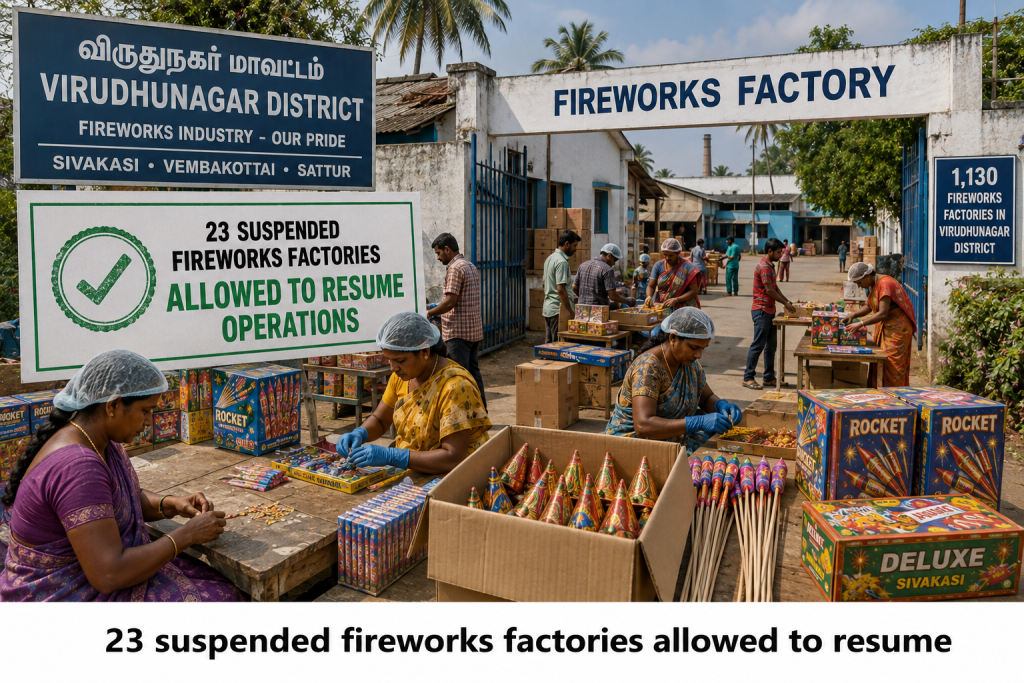
23 suspended fireworks factories allowed to resume

The Tamil Nadu government has announced an integrated drinking-water scheme for Srivilliputhur Municipality as part of a broader package of urban infrastructure projects. The announcement was reported on August 25, 2026, under the State’s urban development programme. The package covers essential civic services including drinking water, sewerage, solid-waste management and roads. Integrated water supply The main objective of the project is to strengthen the drinking-water system in Srivilliputhur Municipality and improve the reliability of water supply to residents. The municipality currently has responsibility for water-supply services, including new household connections, repairs and addressing water-supply complaints. Srivilliputhur Municipality covers about 5.718 sq km and has a recorded population of 75,373 on its official municipal website. This makes dependable water infrastructure particularly important as the town’s residential and commercial requirements continue to grow. Wider urban infrastructure package The drinking-water announcement forms part of a larger urban-development approach rather than being an isolated water project. The package includes improvements relating to: These areas are closely connected. Improving water supply without adequate drainage and sewerage can create sanitation problems, while better waste management and roads contribute to overall public health and urban mobility. Why the project is important Reliable drinking water is one of the most important civic requirements for Srivilliputhur’s residents. A strengthened water-supply system can help reduce interruptions, improve distribution and support the municipality’s ability to meet increasing demand. The municipality’s Citizen Charter already identifies drinking water, drainage, solid-waste management and roads as key public services. It also specifies procedures for responding to water-supply interruptions, leakage, main-pumping repairs and complaints regarding drinking-water quality. Expected benefits for residents Once implemented, the integrated approach is expected to provide broader benefits to the town, including: 1. More dependable water supplyUpgraded infrastructure should help improve the consistency and reliability of municipal drinking-water distribution. 2. Better public healthImproved water and sanitation infrastructure can reduce the risk of contamination and water-related health problems. 3. Improved sanitationCoordination between drinking-water, sewerage and drainage infrastructure can help address wastewater-related problems. 4. Cleaner surroundingsBetter solid-waste management can reduce garbage accumulation and improve environmental hygiene. 5. Better roads and civic infrastructureRoad improvements can make travel easier and support access to residential, commercial and public-service areas. Implementation and next steps The government announcement establishes the project as part of the urban-development package, but specific details such as the project’s individual cost, water source, treatment capacity, pipeline length, number of beneficiaries and completion deadline were not provided in the reliable reports I found. Therefore, those figures should not be added to a magazine article until the detailed government order or project document is available. There is also evidence of ongoing municipal procurement activity: a Tamil Nadu government e-procurement listing published in August 2026 identifies the Commissioner, Srivilliputhur Municipality as the tendering authority for a municipal work, with bidding scheduled to close on August 28, 2026. Overall significance The Srivilliputhur announcement represents a broader effort to improve basic urban infrastructure and quality of life. By bringing drinking water together with sewerage, waste management and road improvements, the government is addressing several interconnected civic needs rather than treating them separately.

Latest news

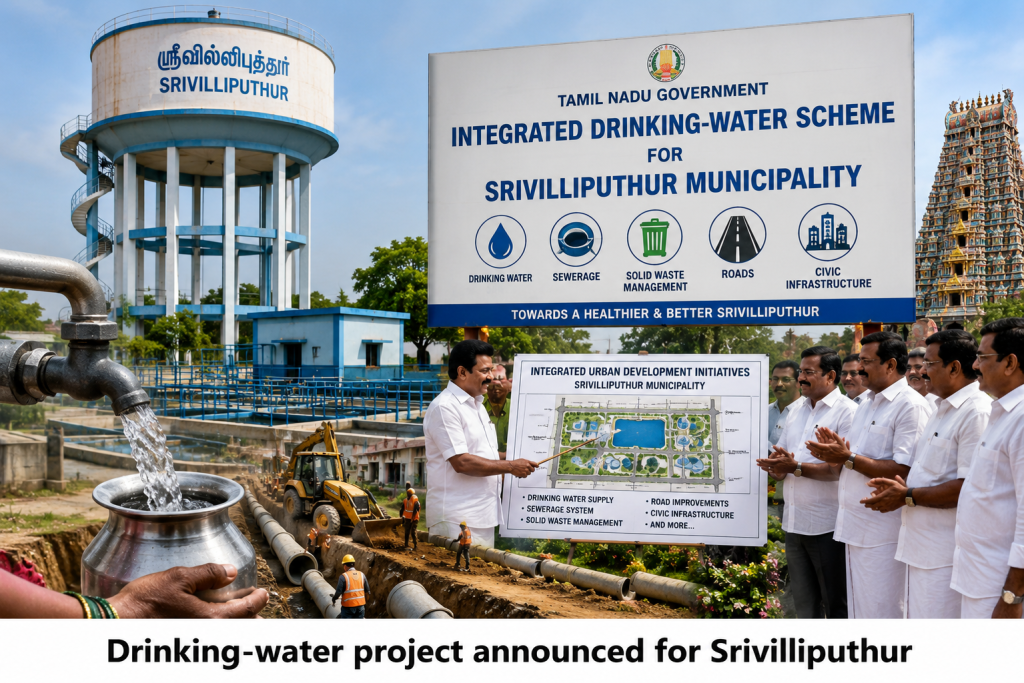
Drinking-water project announced for Srivilliputhur

The Tamil Nadu government has announced an integrated drinking-water scheme for Srivilliputhur Municipality as part of a broader package of urban infrastructure projects. The announcement was reported on August 25, 2026, under the State’s urban development programme. The package covers essential civic services including drinking water, sewerage, solid-waste management and roads. Integrated water supply The main objective of the project is to strengthen the drinking-water system in Srivilliputhur Municipality and improve the reliability of water supply to residents. The municipality currently has responsibility for water-supply services, including new household connections, repairs and addressing water-supply complaints. Srivilliputhur Municipality covers about 5.718 sq km and has a recorded population of 75,373 on its official municipal website. This makes dependable water infrastructure particularly important as the town’s residential and commercial requirements continue to grow. Wider urban infrastructure package The drinking-water announcement forms part of a larger urban-development approach rather than being an isolated water project. The package includes improvements relating to: These areas are closely connected. Improving water supply without adequate drainage and sewerage can create sanitation problems, while better waste management and roads contribute to overall public health and urban mobility. Why the project is important Reliable drinking water is one of the most important civic requirements for Srivilliputhur’s residents. A strengthened water-supply system can help reduce interruptions, improve distribution and support the municipality’s ability to meet increasing demand. The municipality’s Citizen Charter already identifies drinking water, drainage, solid-waste management and roads as key public services. It also specifies procedures for responding to water-supply interruptions, leakage, main-pumping repairs and complaints regarding drinking-water quality. Expected benefits for residents Once implemented, the integrated approach is expected to provide broader benefits to the town, including: 1. More dependable water supplyUpgraded infrastructure should help improve the consistency and reliability of municipal drinking-water distribution. 2. Better public healthImproved water and sanitation infrastructure can reduce the risk of contamination and water-related health problems. 3. Improved sanitationCoordination between drinking-water, sewerage and drainage infrastructure can help address wastewater-related problems. 4. Cleaner surroundingsBetter solid-waste management can reduce garbage accumulation and improve environmental hygiene. 5. Better roads and civic infrastructureRoad improvements can make travel easier and support access to residential, commercial and public-service areas. Implementation and next steps The government announcement establishes the project as part of the urban-development package, but specific details such as the project’s individual cost, water source, treatment capacity, pipeline length, number of beneficiaries and completion deadline were not provided in the reliable reports I found. Therefore, those figures should not be added to a magazine article until the detailed government order or project document is available. There is also evidence of ongoing municipal procurement activity: a Tamil Nadu government e-procurement listing published in August 2026 identifies the Commissioner, Srivilliputhur Municipality as the tendering authority for a municipal work, with bidding scheduled to close on August 28, 2026. Overall significance The Srivilliputhur announcement represents a broader effort to improve basic urban infrastructure and quality of life. By bringing drinking water together with sewerage, waste management and road improvements, the government is addressing several interconnected civic needs rather than treating them separately.

Latest news

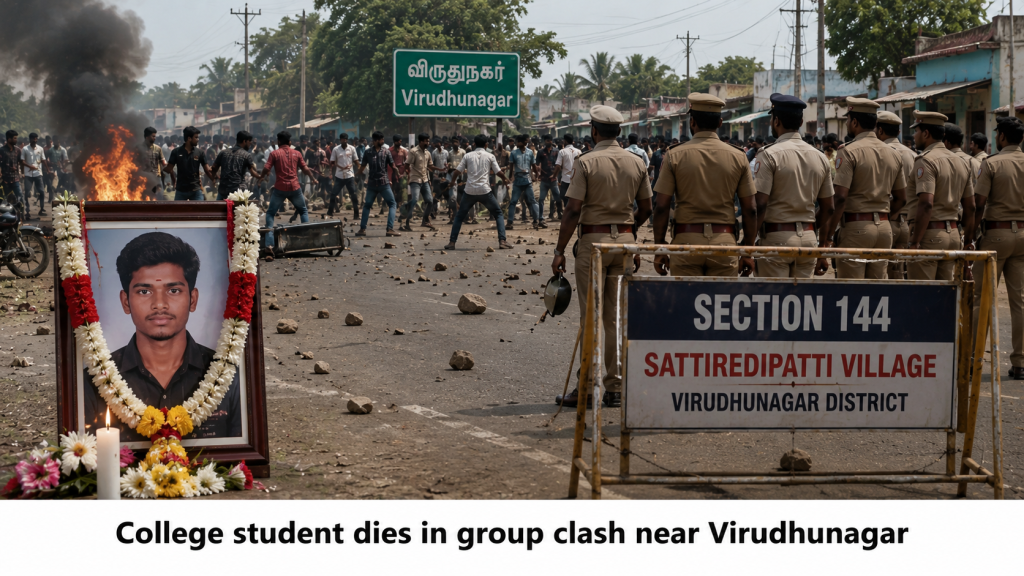
College student dies in group clash near Virudhunagar

What can safely be stated from the information you provided College Student Dies in Group Clash Near Virudhunagar A college student reportedly died following a violent clash between two groups in the Sattireddipatti area near Virudhunagar. The incident created tension in the locality and raised concerns about a possible escalation between the groups. Following the student’s death, authorities reportedly imposed Section 144 restrictions in Sattireddipatti village as a preventive measure. The restrictions were intended to prevent gatherings that could lead to further confrontation and to maintain public order. Police and revenue authorities were expected to maintain a strong presence in the affected area. Residents were advised to cooperate with the authorities and avoid activities that could aggravate tensions. The student’s death has brought renewed attention to the need for prompt police intervention in group disputes and effective measures to prevent retaliatory violence. Further details—including the exact circumstances of the clash, arrests made, the cause of death, and the duration of the restrictions—should be confirmed through an official police statement or a reliable local news report before publication.

About
News
Home
Magazine
Contact