Political News

Political News

DMK organisational changes after the 2026 election

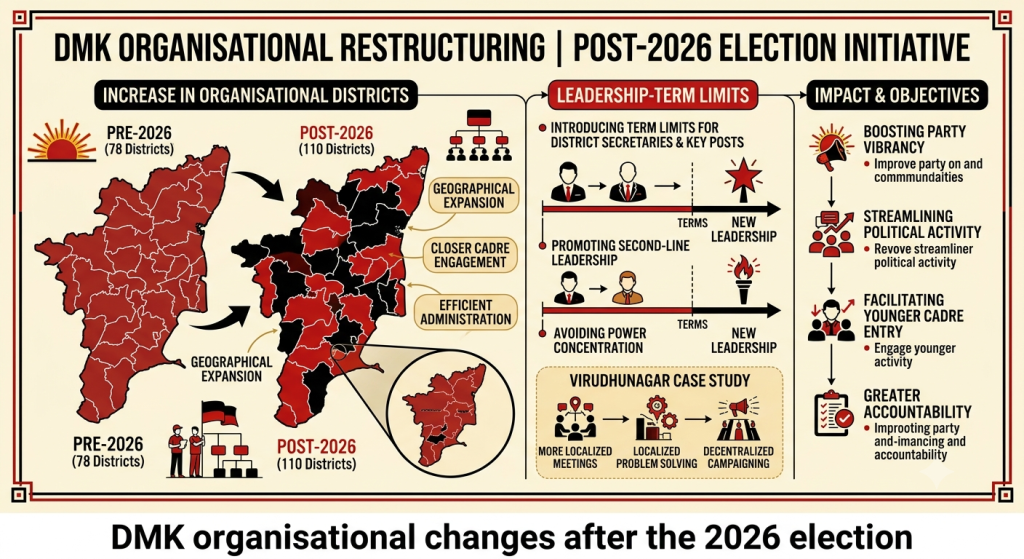
The Dravida Munnetra Kazhagam (DMK) has announced a major internal reorganisation following its setback in the 2026 Tamil Nadu Assembly election. The reforms were approved by the party’s executive committee on 22 August 2026 and are intended to strengthen the party’s grassroots organisation, bring in younger leaders and improve its electoral preparedness. 1. Organisational districts to increase from 78 to 110 The most significant structural change is the decision to increase the number of DMK organisational districts from 78 to 110. Under the proposed structure, each organisational district will broadly cover two Assembly constituencies. The objective is to make the party’s organisation more manageable and improve coordination between the state leadership, district functionaries and constituency-level workers. The party had already been considering a restructuring because its existing organisational boundaries did not always correspond effectively with the changing political and administrative landscape. Reports earlier in August said the proposed changes were intended to strengthen grassroots connectivity and administrative efficiency. 2. Leadership term limits Another major reform is the introduction of term limits for party office-bearers. The new approach limits district secretaries to a specified number of terms, with reports on the August 22 resolution describing a two-term limit. There has been some inconsistency in subsequent reporting over whether the final rule is two or three terms, so the two-term figure should be treated as the reported August 22 resolution unless the DMK publishes a definitive amended rule. One later report, for example, described the limit as three terms. The purpose is to prevent the same individuals from holding powerful organisational positions indefinitely and to create opportunities for new leadership. 3. Age limits for party positions The DMK has also introduced age restrictions for important organisational posts. For district secretaries, the reported maximum age is 70 years. The reform is designed to encourage a generational transition and create greater opportunities for younger party leaders. The reforms are therefore based on three connected ideas: More organisational districts → shorter leadership tenure → greater leadership renewal. 4. Why did the DMK make these changes? The timing is closely connected to the 2026 Assembly election result. The DMK suffered an electoral setback and moved into the Opposition after the election. The party leadership therefore faced questions about: The organisational restructuring is being presented as an attempt to rebuild the party rather than simply change individual leaders. 5. Greater opportunities for younger leaders The age and term restrictions could significantly change the composition of DMK’s district-level leadership. Under the old system, experienced district secretaries could retain influential organisational positions for long periods. The new restrictions could result in more frequent leadership changes. This could give younger leaders opportunities to become: The broader objective is to make the party organisation more dynamic and capable of adapting to changing voter behaviour. 6. Impact on grassroots politics The increase from 78 to 110 organisational districts could make the DMK’s internal administration more decentralised. Instead of one district organisation having to manage a large geographic or electoral area, smaller organisational units could concentrate more closely on individual constituencies. This could improve: Local problem identification → booth-level organisation → voter outreach → constituency campaigning → coordination with district leadership. It may also make it easier for the state leadership to monitor the performance of individual organisational units. 7. Possible impact on Virudhunagar The reforms could be particularly relevant to Virudhunagar district, because the district has seven Assembly constituencies and remains politically important to the DMK. The party currently has important political figures in the district, including Thangam Thennarasu, who represents Tiruchuli. If the new organisational boundaries are implemented, the DMK’s existing district-level structure in Virudhunagar could be redrawn or divided into smaller organisational units depending on the final party plan. That could result in: However, the exact allocation of Virudhunagar’s seven constituencies among the proposed 110 organisational districts has not been publicly established in the reports currently available, so specific new district boundaries should not yet be assumed. 8. What it means for existing district secretaries The reforms could have a significant effect on senior DMK organisers. A district secretary who: could become ineligible for another term in the same position. This does not necessarily mean such leaders will leave the party. They could continue contributing in other capacities, while younger leaders take over formal organisational responsibilities. 9. Nine resolutions for organisational reform The DMK’s executive committee approved nine resolutions connected with the organisational overhaul. The measures include age and tenure restrictions and the expansion of the organisational structure. The reforms therefore represent a broader organisational review rather than simply a decision to increase the number of districts. 10. Political message from M.K. Stalin DMK president M.K. Stalin has sought to frame the election setback as something the party can overcome through organisational renewal. The restructuring sends a message that the party intends to regroup, strengthen its cadre network and prepare for future elections, rather than remain focused solely on analysing the 2026 defeat. This is particularly important because the party now faces a political environment in which TVK has emerged as a major force, while the DMK is seeking to rebuild its position from the Opposition. 11. Why the 110-district model matters The move from 78 to 110 represents an increase of 32 organisational districts, or roughly 41%. That is a substantial organisational expansion. The potential advantages include: 12. Potential challenges The restructuring also carries risks. Creating additional districts could lead to internal competition for new posts. Senior leaders whose positions are affected by the new rules may resist changes, while different local factions could compete for newly created district-secretary positions. There could also be disagreements over: Therefore, implementing the reform may be as politically important as announcing it. 13. What this means for the DMK’s future The reform represents a shift from a relatively established organisational structure toward a model that places greater emphasis on smaller organisational units, leadership rotation and generational change. For the DMK, the ultimate test will be whether these internal changes translate into stronger
Political News

Election-related political developments

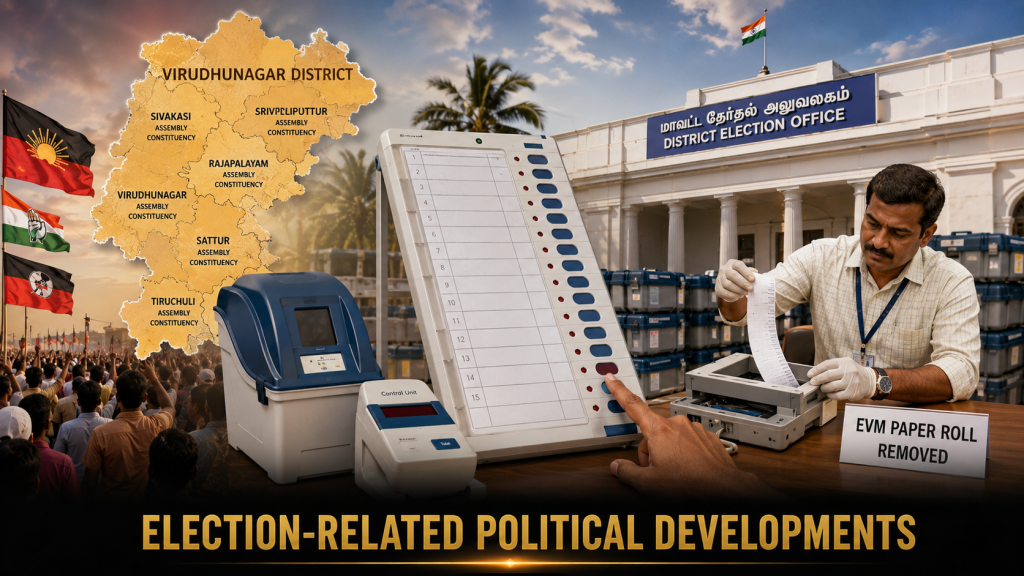
Virudhunagar district remained politically significant during the 2026 Tamil Nadu Assembly election, with all seven Assembly constituencies going to the polls on April 23, 2026. The district’s election administration subsequently completed the counting and post-election procedures. 1. The seven Assembly constituencies The district has seven Assembly constituencies: No. Constituency AC No. 2026 winner 1 Rajapalayam 202 K. Jegadeshwari – TVK 2 Srivilliputhur (SC) 203 Karthik A – TVK 3 Sattur 204 Kadarkarairaj A – DMK 4 Sivakasi 205 S. Keerthana – TVK 5 Virudhunagar 206 P. Selvam – TVK 6 Aruppukottai 207 K.K.S.S.R. Ramachandran – DMK 7 Tiruchuli 208 Thangam Thennarasu – DMK The official district administration lists these seven constituencies and their elected representatives. 2. TVK made a major breakthrough One of the biggest political developments was the performance of Tamilaga Vettri Kazhagam (TVK), the party led by actor-turned-politician Vijay. TVK won four of Virudhunagar’s seven Assembly seats, while DMK won the remaining three. This gave TVK a majority of the district’s Assembly representation. The four TVK victories were: The three DMK victories were: This made Virudhunagar an important district for assessing TVK’s early electoral strength. 3. Sivakasi was particularly significant The Sivakasi constituency attracted considerable attention because S. Keerthana of TVK won the seat. The result also made her the first woman elected as MLA from Sivakasi, according to election reporting. Her victory was particularly important because Sivakasi is one of the district’s major industrial centres, with the fireworks and match industries playing a major role in the local economy. Her subsequent ministerial role has also brought Virudhunagar-related issues—including fireworks safety, industrial inspections and worker welfare—into state-level political discussion. 4. Virudhunagar constituency result In Virudhunagar Assembly Constituency No. 206, TVK’s P. Selvam defeated DMDK candidate Vijayaprabhakar. According to the Election Commission’s result: Selvam’s winning margin was 9,391 votes. The result was politically notable because Vijayaprabhakar was a strong contender and the contest involved several major parties. 5. Thangam Thennarasu retained Tiruchuli Former Tamil Nadu minister Thangam Thennarasu retained the Tiruchuli constituency, where he represents the DMK. This was significant because Thennarasu subsequently became one of the prominent Opposition voices on issues affecting Virudhunagar, particularly the Sivakasi fireworks industry. His criticism of the government’s approach to inspections of fireworks units has become part of the wider political debate over industrial safety and workers’ livelihoods. 6. The election schedule The official Virudhunagar district election page records the following schedule: The district administration published the election information under the supervision of the District Election Officer and Election Commission of India. 7. Post-election EVM/VVPAT procedures After polling and counting, the Election Commission’s procedures require EVMs and VVPAT units to remain under secure custody. ECI documentation states that EVMs are subjected to a two-stage randomisation process, with political-party representatives involved at the relevant stages, and that EVMs/VVPATs are stored in strong rooms following polling. The VVPAT is the component that prints the paper slip showing the candidate selected by the voter. The voter can see the slip through a viewing window before it automatically falls into a sealed drop box. Importantly, the ECI’s procedures distinguish between removing/handling VVPAT paper slips after the required post-counting procedures and disposing of election records. The VVPAT slips are election records and are subject to prescribed storage and retention procedures. 8. About the reported “paper roll removal” You mentioned that the District Election Officer completed the process of removing paper rolls from EVMs used across the seven constituencies. I could confirm that paper rolls are consumable components of VVPATs and that ECI’s EVM manual specifically refers to paper rolls used in VVPATs. However, I could not find a reliable publicly indexed report from the Virudhunagar District Election Officer specifically confirming the date, number of VVPATs or exact procedure described as “removing paper rolls” across all seven constituencies. So I would not treat those details as independently verified. This distinction is important because a VVPAT paper roll contains the printed voting slips; it is not the same thing as the electronic vote data stored in the EVM’s Control Unit. 9. Why the post-election process matters The handling of EVMs and VVPATs after the election is an important part of electoral transparency. The process is designed to ensure: Polling → sealing → secure transportation → strong-room storage → counting → VVPAT verification where applicable → post-counting preservation/handling according to ECI rules. The presence of political-party representatives and prescribed sealing procedures provides additional safeguards around the machines and election records. 10. Political significance of the 2026 result The 2026 result changed the political balance in Virudhunagar. TVK: 4 seatsDMK: 3 seats This means the district became one of the important areas demonstrating TVK’s electoral performance in its first major Assembly contest. At the state level, the ECI’s final results show TVK winning 108 of Tamil Nadu’s 234 Assembly constituencies, making it the largest party in the Assembly. Virudhunagar therefore has significance beyond its seven constituencies: it provides an example of the broader political transition that occurred in Tamil Nadu in the 2026 election. Current political picture As of August 25, 2026, Virudhunagar has four TVK MLAs and three DMK MLAs. The district’s political importance is being reinforced by continuing debates over fireworks-industry regulation, industrial safety, employment, infrastructure and worker welfare.

Political News

Political focus on the fireworks sector

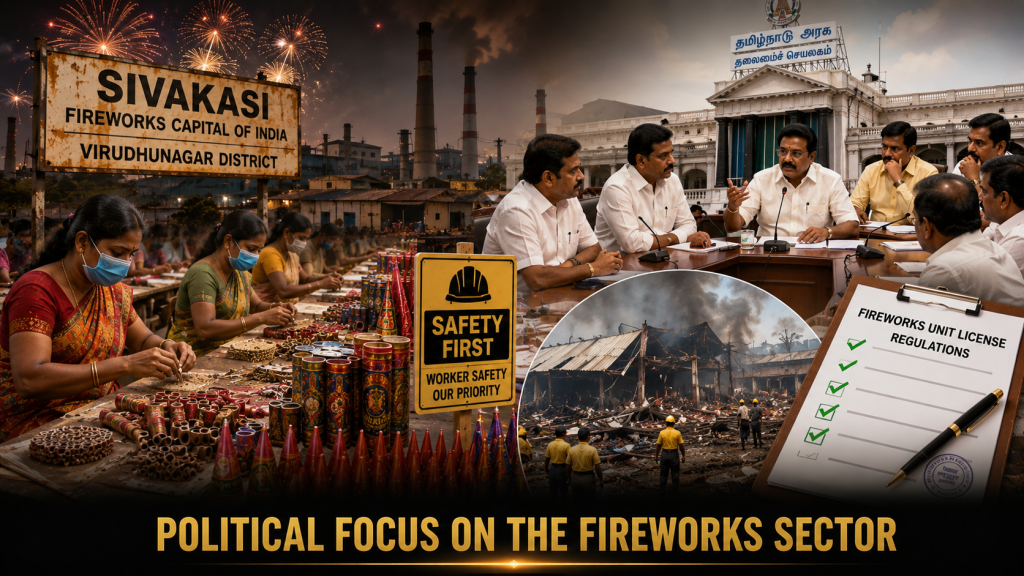
The fireworks industry in Sivakasi and surrounding parts of Virudhunagar district has become an important political and public-policy issue in 2026. The debate centres on a difficult balance: how to protect thousands of workers from deadly industrial accidents while ensuring that safety enforcement does not destroy the livelihood of people dependent on the traditional fireworks economy. Virudhunagar’s own district administration describes Sivakasi as a major centre for crackers manufacturing and matches, reflecting the industry’s importance to the district’s economy. 1. Why fireworks have become a political issue The issue intensified after a series of serious accidents at fireworks factories in Virudhunagar during 2026. One of the most serious incidents occurred at Vanaja Fireworks in Kattanarpatti near Sivakasi on April 19, 2026. The National Human Rights Commission took suo motu cognisance of reports that 18 workers were killed and six injured, with more than 100 workers reportedly present at the factory complex. Other reports gave a higher eventual death toll, illustrating why casualty figures in reporting around the incident can differ as rescue and identification operations progressed. The accident generated questions about working conditions, operating procedures, licensing and enforcement. The issue did not end with the April tragedy. On July 31, 2026, a 55-year-old worker was seriously injured in an explosion at a licensed fireworks factory near Vembakottai while reportedly mixing raw materials. Police registered a case and investigated the cause. These incidents have kept fireworks safety high on the political agenda. 2. The central political debate: safety vs livelihood The controversy essentially has two sides. Government and safety argument The government argues that fireworks manufacturing involves explosive materials and therefore requires strict inspections and enforcement. After several accidents, authorities increased inspections to identify violations before they result in further deaths. Industries Minister S. Keerthana said in the Tamil Nadu Assembly in August that inspections had been conducted for around six months because of safety concerns. According to her statement, there are more than 1,000 fireworks manufacturing units in and around Sivakasi, and inspections identified violations in 177 units. The government’s position is essentially: Opposition and industry argument Former minister and DMK MLA Thangam Thennarasu has taken a different position regarding the inspections. He argued that legitimate licensed factories should not be unnecessarily disrupted by repeated inspections and restrictions. He has said that illegal or genuinely unsafe units should face stringent action, but compliant businesses should be allowed to continue production. His argument is that the controversy is not simply about protecting factory owners; it is about protecting workers whose income depends on the industry. 3. The August 2026 Assembly confrontation The issue became particularly political during an August 20, 2026 Assembly discussion involving Thennarasu and Minister Keerthana. Thennarasu raised concerns that sudden inspections were affecting production and workers in Sivakasi, especially with manufacturers preparing for the festival-season market. Keerthana responded that the inspections were a consequence of repeated accidents and safety concerns. She said authorities had identified violations in 177 units and that corrective action had been taken. She also said the concerns raised by manufacturers and workers had been resolved by August 13. The disagreement therefore became a political argument over whether the inspections represented: necessary safety enforcementorexcessive disruption of a traditional industry. 4. Why worker safety is at the centre of the debate Fireworks manufacturing is particularly hazardous because workers handle combustible and explosive chemical mixtures. The risks include: The July 2026 Vembakottai accident illustrates that even a licensed unit can experience a serious accident. Police said the injured worker had been mixing raw materials when the explosion occurred. This is why the political debate cannot be reduced simply to licensed vs unlicensed factories. Compliance with operational safety requirements is also a major concern. 5. Licensing and regulation Fireworks manufacturing is subject to multiple layers of government oversight. The regulatory framework involves authorities dealing with explosives safety, factories, labour, district administration, police and fire services. A July 2026 Madras High Court proceeding concerning fireworks safety specifically involved the Virudhunagar District Collector, Superintendent of Police, Petroleum and Explosives Safety Organisation authorities, Fire and Rescue Services, Labour officials and Factory Inspectorate, demonstrating the multi-agency nature of regulation. The courts have also repeatedly stressed that safety requirements must be enforced because accidents can result in deaths and serious injuries. 6. Madras High Court’s position The judiciary has recognised the unusual economic importance of the fireworks sector while simultaneously emphasising safety. In a February 2026 judgment, the Madras High Court observed that fireworks manufacturing provides employment to a considerable section of Virudhunagar’s population and that alternative employment opportunities in the district can be limited. At the same time, the Court acknowledged the history of fatal accidents and the government’s safety regulations. This is an important point because it closely mirrors the political debate: The industry needs to survive, but it must survive safely. The same judgment noted the historically high concentration of fireworks factories and explosives-related facilities in parts of Virudhunagar, particularly around Sivakasi, Sattur and Virudhunagar. 7. Economic importance of the industry Fireworks are not just a manufacturing activity in Virudhunagar. They form part of a much wider economic network. The sector supports: Thennarasu has argued that the fireworks and match industries have sustained the region for decades and provide direct and indirect employment to a very large number of people. Because of this economic dependence, any major shutdown or prolonged disruption can have consequences beyond factory owners. 8. Political demand for worker protection The political debate has increasingly shifted toward worker welfare, rather than simply protecting the fireworks manufacturers. The main demands include: Better safety training Workers should receive regular training in handling explosive materials and responding to emergencies. Stronger inspections Factories should be inspected regularly, but inspections should identify genuine violations and ensure that corrective action follows. Better emergency infrastructure Fire and rescue capabilities around industrial clusters need to be strong enough to respond rapidly to accidents. Compensation Families of workers killed or seriously injured in accidents need timely financial assistance and rehabilitation. Health protection Workers exposed to

Political News

S. Keerthana’s rise in Tamil Nadu politics

S. Keerthana emerged as one of the most prominent young political figures in Tamil Nadu after the 2026 Assembly election. At 29, she won the Sivakasi Assembly constituency on a Tamilaga Vettri Kazhagam (TVK) ticket and subsequently joined Chief Minister C. Joseph Vijay’s cabinet. She was widely reported as the youngest minister in the new government. 1. Historic victory in Sivakasi Keerthana’s election victory was significant because she became the first woman MLA elected from Sivakasi, ending nearly seven decades of male-only representation in the constituency. In the 2026 election, she received 68,709 votes, while Congress candidate G. Ashokan received 57,039. AIADMK’s K. T. Rajenthra Bhalaji finished third with 51,078 votes. This gave Keerthana a victory margin of roughly 11,670 votes, according to election-result reporting. 2. From political strategist to MLA Keerthana did not come into electoral politics through a traditional political-family route. Before entering active politics, she worked as a political consultant and campaign strategist. Reports say she worked with organisations including Showtime Consulting and I-PAC, gaining experience in election campaigns involving parties such as the Telugu Desam Party, Trinamool Congress and DMK. That background gave her experience in: She subsequently entered electoral politics with TVK. 3. Educational background Keerthana was born in Virudhunagar district in 1996. Reports state that she studied in a Tamil-medium government school before pursuing higher education. Her reported educational qualifications include: Her combination of statistical education and political consulting experience has contributed to her image as a young, data-oriented political leader. 4. Entry into TVK Keerthana joined Tamilaga Vettri Kazhagam, the political party led by actor-turned-politician Vijay. She became one of the party’s prominent young candidates in its first major Assembly election. Her selection was notable because she did not have the conventional profile of a long-time politician or established political heavyweight. She has explained her attraction to TVK in terms of its openness to people without traditional political or financial backgrounds. Her victory therefore became an important example of TVK’s attempt to bring younger and professionally experienced people into electoral politics. 5. Focus on Sivakasi’s major problems During the campaign, Keerthana focused heavily on issues affecting Sivakasi. One of the major concerns she highlighted was industrial safety. Sivakasi is one of India’s major fireworks-manufacturing centres, and she pointed out that the constituency faces significant industrial risks. She reportedly highlighted the fact that the area had only one fire station despite its industrial-risk profile and called for stronger emergency and safety infrastructure. She also focused on healthcare infrastructure, particularly the need for specialised government medical facilities. 6. Fireworks workers and industry Because Sivakasi’s economy is closely linked to fireworks manufacturing, Keerthana’s campaign also addressed the welfare of workers in the sector. Her reported proposals included: She also proposed measures intended to help industrialists and improve the industry’s global competitiveness, including an exposure programme for unit owners. This background is particularly relevant to the current political controversy surrounding fireworks-unit inspections and safety enforcement in Sivakasi. 7. Becoming the youngest minister After winning the Sivakasi seat, Keerthana was included in Vijay’s first cabinet and took oath on 10 May 2026. At 29, she became the youngest minister in the Vijay-led government, according to multiple reports. Her elevation was significant because she moved from: Political strategist → First-time candidate → MLA → Cabinet minister within a very short period. 8. Language skills Another feature that attracted attention was Keerthana’s reported ability to speak five languages. NDTV reported that she could speak Tamil, English, Hindi and Telugu fluently, among the languages she used professionally. She said her multilingual ability had helped her work across different states and interact with a wider range of people. Her use of Hindi subsequently became a subject of political discussion in Tamil Nadu because language policy and opposition to Hindi imposition have historically been sensitive issues in the state’s politics. 9. A new generation of political leadership Keerthana’s rise is significant beyond her individual victory. Her profile represents several changes in Tamil Nadu politics: Youth: At 29, she is considerably younger than many established political leaders. Women in politics: Her Sivakasi victory broke the constituency’s long history of male-only representation. Professional expertise: Her previous career in political consulting gave her experience in campaign strategy and data-driven politics. New-party politics: She became an MLA during TVK’s first major electoral contest. Technocratic image: Her mathematics and statistics background, combined with campaign experience, has contributed to her image as a more professionally oriented politician. 10. Her role in the new government Keerthana’s appointment also demonstrated the TVK government’s effort to combine young political faces with experienced leaders. Her responsibilities have placed her in the middle of major policy discussions, including industrial development and the fireworks sector. Her public statements on industrial safety and social issues have also made her increasingly visible beyond Sivakasi. As of August 2026, she remains one of the most closely watched young figures in the Tamil Nadu government. Her future political influence will depend on how effectively she delivers on the promises made to Sivakasi’s residents, particularly regarding industrial safety, healthcare, workers’ welfare, infrastructure and employment.

Political News

Sivakasi fireworks industry becomes a political issue

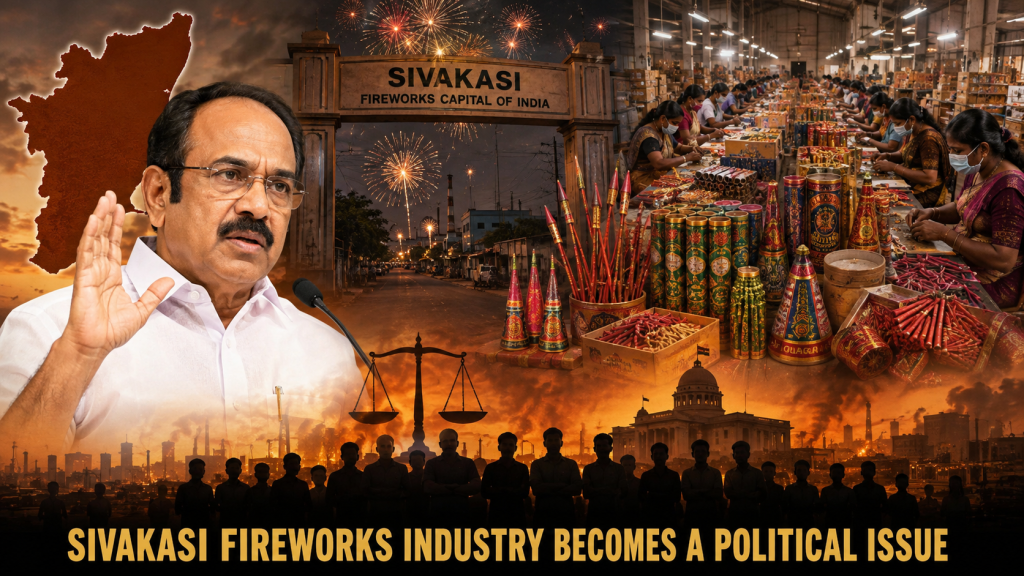
The issue became a major political controversy in August 2026, after former Tamil Nadu Finance Minister and DMK MLA Thangam Thennarasu criticised the state government over inspections and restrictions affecting fireworks manufacturers in Sivakasi, Virudhunagar district. What triggered the controversy? Thennarasu alleged that licensed fireworks manufacturing units were also being subjected to sudden inspections, rather than action being limited to illegal or non-compliant units. He argued that the inspections were disrupting production at a particularly important time ahead of the Deepavali season, when manufacturers normally increase production. He said there was no objection to strict action against illegal factories or units violating safety regulations, but argued that businesses operating legally should not be unnecessarily disrupted. He also linked the issue to the livelihoods of workers who depend on the fireworks sector. Thennarasu’s main allegations According to reports, Thennarasu claimed that: At a protest in Sivakasi, he reportedly stressed that the issue was not simply about protecting manufacturers but about protecting the workers whose livelihoods depend on the industry. Government’s response Industries Minister S. Keerthana rejected the criticism and said the inspections were primarily a safety measure, not an attempt to target legitimate businesses. According to her explanation in the Tamil Nadu Assembly: The minister also accused the Opposition of politicising an industrial-safety issue after the government said the immediate problems had been resolved. What happened in the Assembly? The controversy reached the Tamil Nadu Legislative Assembly on August 20, 2026. Thennarasu raised the matter during Zero Hour and said surprise inspections were hurting fireworks production. He particularly highlighted the timing of the inspections because manufacturers were preparing for Deepavali and would also face difficulties during the approaching monsoon period. Minister Keerthana responded that the issue had already been resolved and that workers had returned to their factories. She also alleged that political parties were encouraging protests and creating confusion. Thennarasu rejected that accusation and maintained that the protests were a democratic expression of the concerns of workers and manufacturers. Why is Sivakasi so important? Sivakasi is one of India’s most important fireworks manufacturing centres. The industry is deeply connected with the wider economy of Virudhunagar district, supporting not only fireworks production but also related activities such as printing, packaging, transportation, wholesale and retail trade. A recent Tamil Nadu High Court judgment also recognised the industry’s importance, stating that fireworks manufacturing provides employment to a considerable section of Virudhunagar’s population and that many people have limited alternative employment opportunities. At the same time, the Court emphasised that fatal accidents have occurred and that stringent safety measures are necessary. Thennarasu said in his August 4 statement that the industry had an annual turnover of approximately ₹6,000 crore and generated direct and indirect employment for more than 7 lakh people. There are different estimates for the industry’s employment and turnover depending on the source and what activities are included, so these figures should be treated as reported estimates rather than a single official count. The safety issue behind the politics The government’s argument is important because Sivakasi’s fireworks industry has a long history of industrial accidents. Courts have repeatedly stressed that licensing, inspections, worker training and compliance with explosives and factory-safety regulations are essential. A July 2026 High Court proceeding specifically described the need for coordinated regulation involving the District Collector, police, explosives authorities, Labour Department and industrial-safety officials. A 2025 High Court ruling likewise directed authorities to strictly enforce safety requirements, including licensing limits, appointment of safety personnel, periodic inspections and safety training. This creates the central tension in the current controversy: Industry side: excessive or poorly timed inspections can interrupt production and threaten workers’ livelihoods. Government/safety side: inspections are necessary because fireworks manufacturing involves explosives and previous accidents demonstrate the consequences of inadequate compliance. Why it has become a political issue The dispute has therefore developed into more than an argument about factory inspections. It has become a debate over how the government should balance industrial safety with employment and economic activity. The Opposition’s position is essentially that authorities should take strong action against illegal and unsafe units while allowing compliant licensed factories to continue operating normally. The government’s position is that safety inspections cannot be relaxed simply because the industry is economically important. Current situation As of the latest reports in August 2026, the government says the immediate concerns raised by workers and manufacturers had been resolved and that workers had returned to the factories. However, Thennarasu and the Opposition continued to argue that the inspection process had caused unnecessary disruption and that legitimate units should not be treated in the same manner as illegal operators.

About
News
Home
Magazine
Contact