High Court order over temple festival dispute
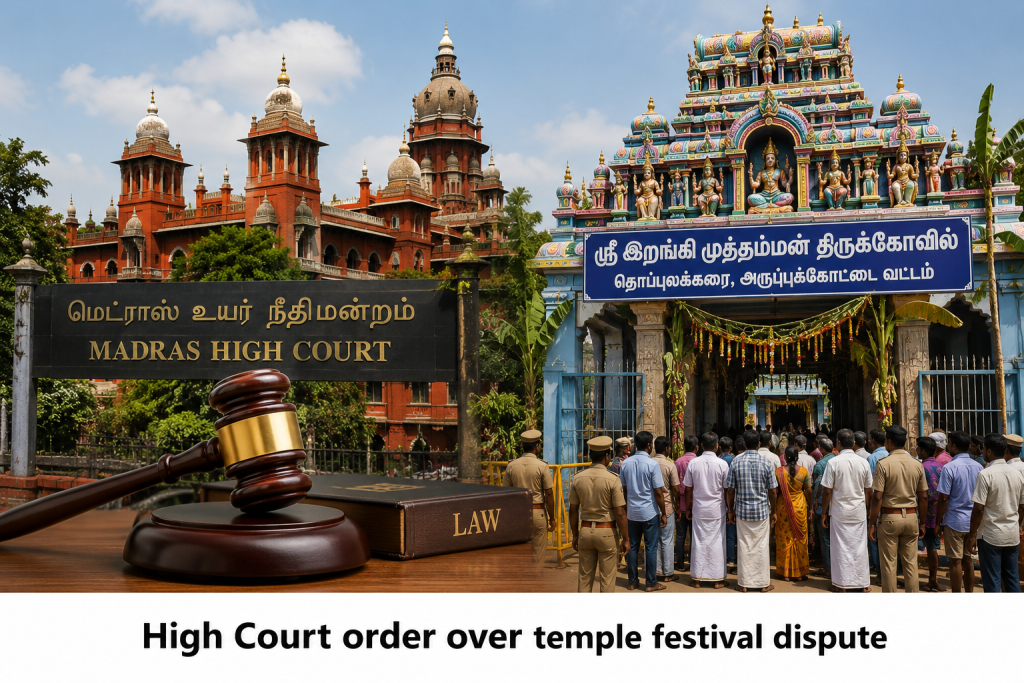
The Madurai Bench of the Madras High Court, in an order dated August 3, 2026, dealt with a long-running dispute concerning Arulmigu Sri Renganachiamman Temple, also known as Sri Irangi Muthamman Temple, at Thoppulakkarai in Aruppukkottai Taluk, Virudhunagar district. The immediate issue was permission to conduct the Aadi festival scheduled from August 10 to 14, 2026, amid competing claims over the temple’s administration and customary festival rights. Background of the dispute The dispute is not new and has reportedly continued for several years. One group claimed that the temple and its festivals had traditionally been managed by six communities — Maravar, Agamudaiyar, Vellalar, Asari, Iyengar and Pandaram. Members of the Rajakambala Nayakkar community, however, disputed the claim of exclusive control and sought participation in the administration and festival rituals. The competing sides presented different accounts of the temple’s historical management and customary practices. The High Court noted that the dispute involves much more than the arrangements for a single festival. Questions concerning ownership, administration, customary practices, ritual rights and the right to organise festivals remain contested. Request for police protection A petitioner associated with the festival committee approached the High Court after authorities refused permission for the proposed Aadi festival. The petitioner sought an order directing the police to provide protection so that the festival could be conducted from August 10 to August 14, 2026. The police had refused permission because of the history of conflict between the groups and the authorities’ assessment that permitting one faction to conduct the festival could create a law-and-order problem. The court noted that previous disputes had resulted in criminal cases, including cases relating to unlawful assembly, rioting, assault, damage to property and obstruction of public servants. Revenue Divisional Officer’s order The Revenue Divisional Officer (RDO), Aruppukkottai, had conducted an enquiry on July 6, 2026, involving officials and representatives of the competing groups. The RDO subsequently issued proceedings on July 10, 2026. Among other things, the proceedings stated that no community should prevent members of another community from worshipping at the temple and that parties claiming ownership or customary rights should approach the competent Civil Court. The RDO also directed that no individual community should conduct a separate festival while the underlying dispute remained unresolved. What the High Court decided The High Court declined to issue a positive direction allowing the petitioning faction to conduct the 2026 Aadi festival with police protection. The court reasoned that granting such permission to one faction could effectively appear to recognise that faction’s disputed claim to administer the temple or conduct its festival. The court held that the writ proceedings were not the appropriate forum to determine those underlying civil and customary rights. Importantly, the court did not decide which faction owns or controls the temple. Instead, it directed the parties to approach the competent Civil Court for a comprehensive determination of their respective claims. Why the Civil Court is important The High Court observed that determining the competing claims would require examination of evidence concerning: Such questions require pleadings, documentary evidence and oral evidence, which are more appropriately examined by a Civil Court rather than decided through writ proceedings. Earlier court orders The High Court also examined several earlier proceedings concerning the temple. It emphasised that festival-specific orders passed in previous years should not automatically be treated as permanent declarations of ownership or customary rights. The court said that previous directions concerning particular festivals were made to address immediate situations and did not necessarily finally determine the long-term rights of either faction. Right to worship protected Although the court refused to recognise either faction’s exclusive festival claim, it made an important distinction between the right to worship and the right to administer the temple. The court directed that people should not be prevented solely because of their caste or community from offering ordinary worship, subject to reasonable regulation and any orders of a competent court. At the same time, ordinary worship does not automatically create a right to administer the temple, hold its keys, collect contributions, organise festivals or perform disputed rituals. Those matters must be established through the appropriate legal process.